
5s
+1
Submission successful!

|
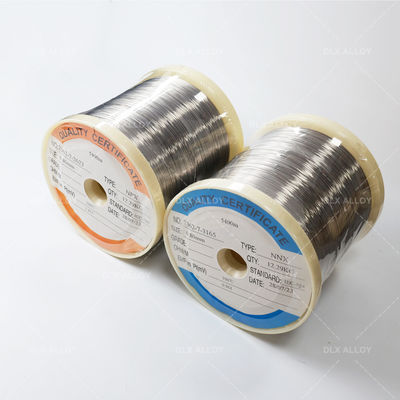
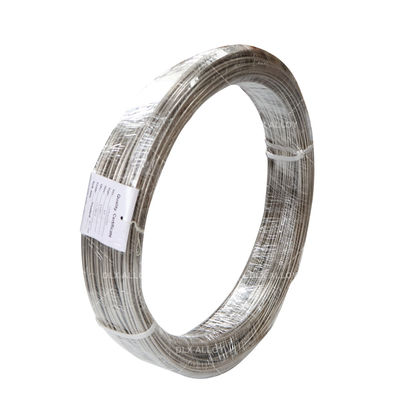
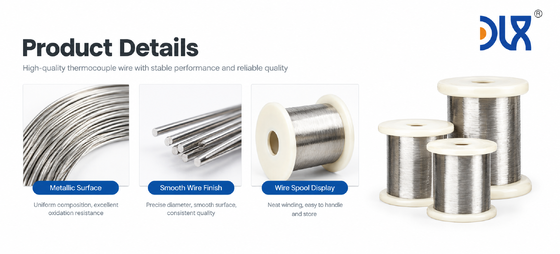
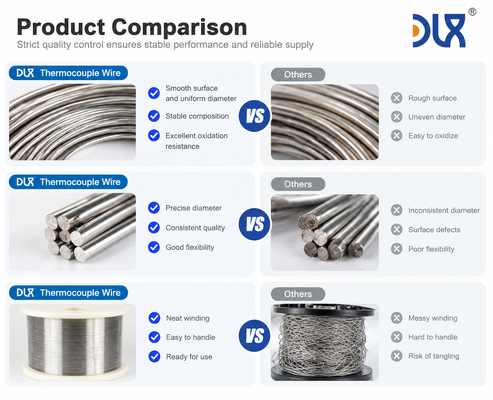
| Brand Name: | DLX |
| Model Number: | Type N Thermocouple Wire |
| MOQ: | 5kg |
| Payment Terms: | L/C,D/A,D/P,T/T,VTB |
| Supply Ability: | 1200 tons per month |
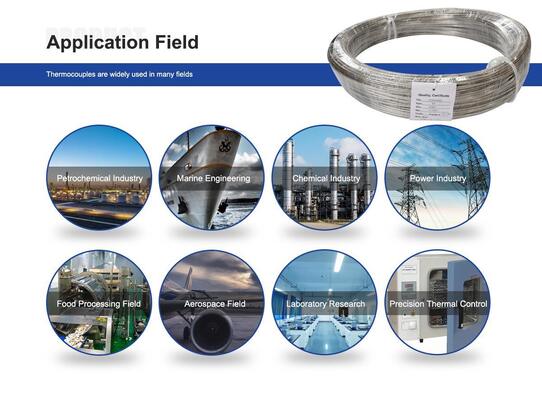
Engineered for critical thermal tracking in continuous heat treatment, ceramic sintering, and vacuum furnace environments, DLX 0.5mm Type N thermocouple wire delivers exceptional thermoelectric stability and oxidation resistance up to 1250°C. Composed of ultra-pure Nicrosil (positive leg) and Nisil (negative leg) conductors, this high-grade thermal sensor alloy overcomes short-range ordering and "Green Rot" degradation commonly found in conventional base-metal sensors.

Continuous industrial heating processes require precise temperature feedback without sensor signal drift. DLX 0.5mm Type N thermocouple wire is manufactured using vacuum induction melting (VIM) and precision wire-drawing technologies. By introducing controlled silicon and chromium ratios, the alloy forms a tenacious, self-healing oxide barrier that retards internal oxidation and grain growth at elevated temperatures.
Compared to legacy Type K alternatives, our 0.5mm Nicrosil-Nisil pairs exhibit significantly reduced EMF drift under thermal cycling, making them the preferred conductor choice for OEM temperature sensor manufacturers, industrial furnace builders, and automated pyrometry assemblies.
| Parameter | Positive Leg (NP - Nicrosil) | Negative Leg (NN - Nisil) | Complete Couple (Type N) |
|---|---|---|---|
| Nominal Chemical Composition | Ni-14.2%Cr-1.4%Si | Ni-4.4%Si-0.1%Mg | Matched Thermoelectric Pair |
| Conductor Diameter | 0.50 mm (±0.008 mm precision tolerance) | 0.50 mm (±0.008 mm precision tolerance) | 0.50 mm (Matched Spools) |
| Continuous Operating Range | -270°C to +1250°C | -270°C to +1250°C | 0°C to +1250°C |
| Short-Term Peak Temperature | Up to +1300°C | Up to +1300°C | Up to +1300°C |
| Melting Point | 1420°C | 1340°C | High-Temperature Resistant |
| Density (g/cm³) | 8.53 | 8.58 | – |
| Resistivity at 20°C (μΩ·m) | ~1.00 | ~0.36 | – |
| Calibration Class / Tolerance | Class 1 / Special Tolerance (±1.5°C or ±0.0040× | t | ) |
| Conductor Temper / Finish | Bright Annealed (M-temper) / Clean Smooth Surface | Bright Annealed (M-temper) / Clean Smooth Surface | Spool / Coil / Cut-to-length |
The optimized silicon addition suppresses lattice-level magnetic and structural rearrangements between 250°C and 550°C, ensuring reversible, drift-free thermal voltage output throughout long production campaigns.
The passive silicon-chromium oxide film prevents progressive subsurface embrittlement in air, inert gas, and high-temperature oxidizing furnace environments up to 1250°C.
With precision bright annealing, our 0.5mm thermocouple wire provides smooth flexibility for seamless mineral-insulated (MI) cable fabrication, ceramic bead threading, and sensor probe assembly without surface micro-cracking.
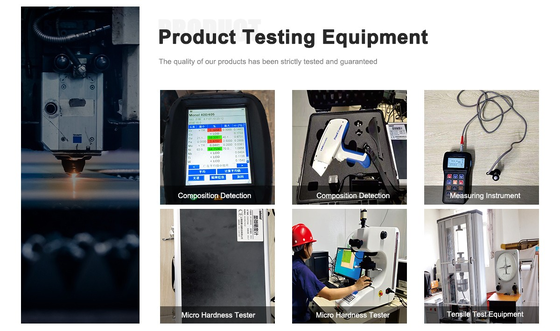
Every production heat is tested against high-purity platinum calibration baselines to guarantee Class 1 thermoelectric reproducibility from master spool to finished sensor lead.
A: Type N wire significantly mitigates two major failure modes of Type K at high temperatures: preferential chromium oxidation ("Green Rot") and short-range ordering EMF drift. In fine diameters like 0.5mm, Type N provides substantially longer operational life and higher calibration integrity above 1000°C.
A: We supply matched NP and NN conductor pairs on standard plastic spools (such as DIN125 or DIN200), large master spools for automated winding lines, or precision cut straight lengths. Custom spool weights and protective moisture-proof export packaging are provided standard.
A: Every master lot undergoes multi-point thermoelectric voltage testing across the operating temperature curve against reference standards to ensure strict compliance with Class 1 / Special Tolerance limits. Complete inspection certificates accompany each commercial shipment.
A: Bare Type N wire excels in clean oxidizing atmospheres, inert gas environments, and controlled vacuum conditions. For sulfurous or reducing atmospheres, appropriate ceramic or metal protective sheathing is recommended.


 english
 français
 Deutsch
 Italiano
 Русский
 Español
 português
 Nederlandse
 ελληνικά
 日本語
 한국
 中文
 العربية
 हिन्दी
 Türkçe
 indonesia
 tiếng Việt
 ไทย
 বাংলা
 فارسی
 polski