
5s
+1
Submission successful!

|
| Brand Name: | DLX |
| Model Number: | Pure Nickel |
| MOQ: | 5kg |
| Price: | Custom orders based on provided images |
| Payment Terms: | L/C,D/A,D/P,T/T,Western Union |
| Supply Ability: | 500 tons per month |
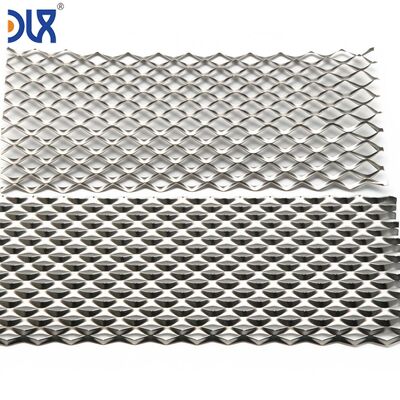
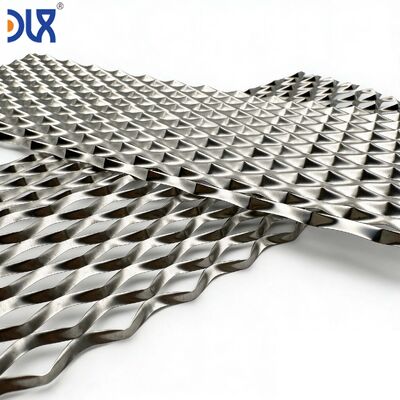
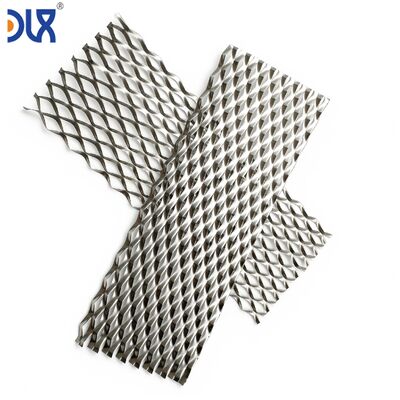
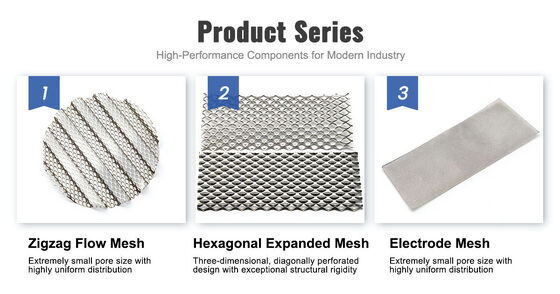
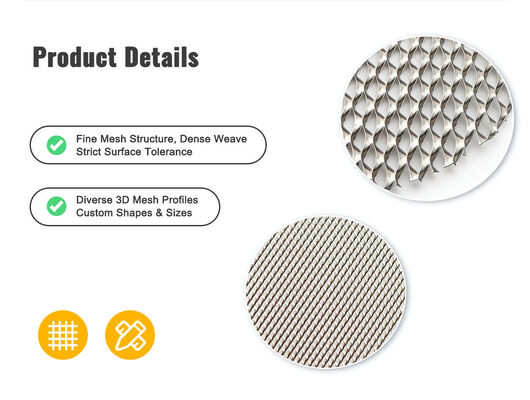
Not all electrode meshes should be woven. For hydrogen electrolyzer gas diffusion layers (GDL) and porous transport layers (PTL), expanded nickel mesh — with its characteristic fish scale diamond pattern — offers a fundamentally different set of advantages: no crossing wires to create contact resistance, no weave intersections to trap gas bubbles, and a flat, continuous surface that distributes compression load uniformly across the membrane. At Changzhou DLX Alloy Co., Ltd., we slit and stretch our own pure nickel sheet into expanded mesh in-house — controlling sheet thickness, strand width, long-way diamond (LWD) opening, and final flatness to match your electrolyzer cell design. Full melt-to-mesh traceability on every shipment.
| Characteristic | Woven Mesh (Plain / Twill / Dutch) | Expanded Mesh (Fish Scale) | Electrolyzer Impact |
|---|---|---|---|
| Structure | Warp and weft wires crossing at 90° | Single sheet slit and stretched — no joints, no crossings | Expanded: uniform electrical path. Woven: contact resistance at every wire intersection (hundreds per cm²). |
| Surface profile | Knuckles where wires cross — high points that concentrate compression | Nominally flat surface — strand and bond areas in the same plane | Expanded: uniform compression on membrane → no localized high-pressure points. Woven: wire knuckles can indent membrane over time. |
| Gas bubble release | Weave intersections trap bubbles in the corners | Diamond openings are smooth-walled — bubbles slide through | Expanded: faster gas release from electrode gap → lower overpotential at high current density. Critical above 350 mA/cm². |
| Open area control | Determined by wire diameter and mesh count | Determined by strand width and LWD — independently adjustable | Expanded: fine-tune open area % without changing mesh thickness. Woven: changing open area changes thickness. |
| Mechanical integrity | Relies on wire tension — individual wires can shift | Monolithic — strands and bonds form a continuous single piece | Expanded: cannot unravel. Woven: loose wire ends at cut edges require careful handling to prevent shorts. |
| Parameter | Typical Electrolyzer Range | What It Affects |
|---|---|---|
| Sheet thickness (pre-expansion) | 0.15–0.50 mm | Determines strand cross-section → electrical resistance per unit length and compression thickness under stack load |
| Strand width | 0.4–1.2 mm | Wider strand = lower resistance but less open area. Narrower strand = more open area but higher IR drop. Optimum is cell-specific. |
| LWD (long way of diamond) | 1.5–6.0 mm | The long axis of the diamond opening. Larger LWD = larger gas escape channels. Must balance with strand width for mechanical strength. |
| SWD (short way of diamond) | 1.0–3.5 mm | The short axis of the diamond. SWD + LWD define the open area percentage. Lower SWD = denser mesh with more contact points per cm². |
| Open area | 30–65% typical for GDL/PTL | Higher open area = better gas release but less in-plane conductivity. Lower open area = better conductivity but slower gas escape. |
| Sheet dimensions | Custom L * W to cell frame | Cut to size with clean edges. Laser or shear cut — no wire ends to fray because expanded mesh has no wire ends. |
Optimizing for your cell? Send us your target current density, gas production rate per cell, and membrane type. We recommend initial LWD, strand width, and open area — then iterate based on your single-cell test data.
| Cell Position | Function | Why Expanded Mesh Is Often Preferred |
|---|---|---|
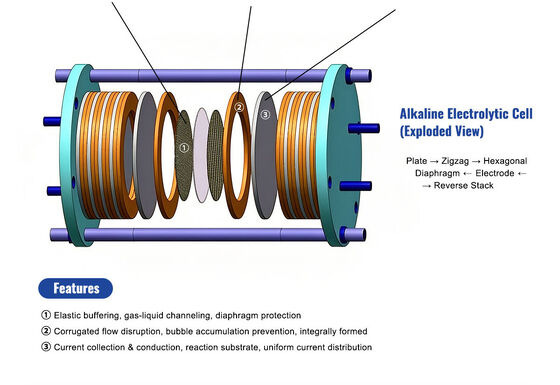
| Cathode gas diffusion layer (ALK) | Distribute current to cathode electrode; transport H₂ bubbles away from membrane | Diamond openings provide unrestricted vertical gas escape path. No weave corners to trap H₂ microbubbles — critical for high-rate hydrogen production. |
| Anode porous transport layer (PEM) | Distribute water to anode catalyst; transport O₂ bubbles away; conduct electrons from catalyst to bipolar plate | Flat surface protects the thin PEM membrane from localized puncture. Continuous electrical path through strands — no contact resistance at wire crossings. Suitable as a PTL layer between catalyst-coated membrane and bipolar plate flow field. |
| Electrode substrate (ALK — catalyst coating base) | Provide high surface area base for Raney nickel or noble metal catalyst coating; conduct current to coating | Strand surface is smooth and continuous — catalyst coating deposits more uniformly than on woven mesh where wire curvature creates coating thickness variation. |
| Current collector / flow field (PEM) | Bridge gap between GDL and bipolar plate; provide flow channels for water and gas | Open area can be tuned independently of thickness. High open area for low-pressure-drop water delivery; sufficient strand metal for current collection. No wire crossings to increase pressure drop. |
Most expanded mesh on the market begins with purchased nickel sheet — the mesh manufacturer has no control over the chemistry, the rolling history, or the surface condition of the raw material. At DLX, the process starts with our own pure nickel ingots. We hot roll them to strip, cold roll to your specified thickness, slit to the width required by your expanding tooling, and stretch on our expanding press. The entire sequence happens in one facility under one quality system.
Why does this matter for electrolyzer performance? Because the surface chemistry of the nickel sheet — before it ever enters the expanding press — determines the surface chemistry of the finished mesh. If the sheet was contaminated with iron from steel work rolls at a third-party rolling mill, that iron is now embedded in your electrode mesh surface. It will dissolve into the KOH electrolyte over hundreds of operating hours, redeposit on the cathode, and increase the overpotential. We prevent this by doing the rolling ourselves, in a facility where the work rolls only contact nickel alloys.
Source: DLX Alloy product catalog. Chemistry certified from ingot to finished mesh.
| Element (%) | N4 | N6 | Ni200 | Ni201 |
|---|---|---|---|---|
| Ni+Co | ≥99.9 | ≥99.5 | — | — |
| Ni | — | — | ≥99.2 | ≥99.0 |
| Fe | ≤0.04 | ≤0.1 | ≤0.4 | ≤0.4 |
| Cu | ≤0.015 | ≤0.1 | ≤0.25 | ≤0.25 |
| C | ≤0.01 | ≤0.1 | ≤0.15 | ≤0.02 |
| Si | ≤0.03 | ≤0.1 | ≤0.35 | ≤0.35 |
| Mn | ≤0.002 | ≤0.05 | ≤0.35 | ≤0.35 |
| S | ≤0.001 | ≤0.005 | ≤0.01 | ≤0.01 |
| Stage | Inspection | Why It Matters |
|---|---|---|
| Ingot chemistry | OES per melt; Fe, Cu, C verified | Fe in nickel = catalyst for oxygen evolution side reaction at the anode → reduced Faraday efficiency. We control it from the ingot. |
| Cold-rolled sheet | Thickness profile across width; surface inspection for rolling defects | Thickness variation in the sheet becomes strand width variation in the expanded mesh → non-uniform current distribution across the electrode area. |
| Expanding process | LWD, SWD, strand width measured per coil; visual for broken strands, inconsistent diamonds | A broken strand creates a dead zone — no electrical path through that section of the electrode. Detected at our facility, not during your stack conditioning cycle. |
| Post-anneal flatness | Granite surface plate; deviation from plane recorded | Expanded mesh that is not flat after annealing will not lie flat under compression — creating uneven pressure distribution on the membrane. |
| Sheet dimensions | L * W ±0.5 mm; edge inspection for burrs | Expanded mesh edges must be burr-free — a sharp edge under compression can cut into the membrane. |
| Documentation | EN 10204 3.1 MTC + dimensional report + mesh parameter report (LWD, SWD, strand width, open area %) | Complete traceability from nickel ingot through finished electrode mesh sheet. |
Third-party inspection by SGS, BV, or TÜV available. Free sample of 5 sheets for first-time electrolyzer OEM evaluation.
| Sheet protection | Each expanded mesh sheet interleaved with acid-free tissue. Stacked flat between rigid backing boards. Since expanded mesh has no wire ends, handling damage during stacking is minimal — but we protect against bending and creasing regardless. |
| Crating | Flat-packed in desiccant-sealed polyethylene, enclosed in plywood crate. Internal bracing prevents sheet movement during transit. |
| Identification | Grade, ingot heat number, sheet thickness, LWD * SWD, strand width, open area %, sheet dimensions, DLX traceability code on crate label and packing list. |
| Sample MOQ | 5 sheets — free for qualified electrolyzer OEM evaluation. |
| Production MOQ | 50 sheets per specification. |
| Lead Time | 3–7 days for trial with in-stock sheet thickness; 4–6 weeks for custom sheet thickness + new LWD tooling. |
| Shipping | Air (DHL, FedEx) for trial; sea (FCL) for production. |
| Payment | T/T for trial; T/T or L/C at sight for production. |
It depends on your current density target. Below 300 mA/cm², the difference is marginal — both mesh types perform adequately. Above 350 mA/cm², gas bubble management becomes the dominant loss mechanism, and expanded mesh's smooth-walled diamond openings typically show 15–30 mV lower bubble overpotential than an equivalent woven mesh. We can supply both types — provide your target current density and we will recommend, or we can send sample sheets of each for side-by-side single-cell testing.
Yes. Send us a sample of your current mesh — we will measure the LWD, SWD, strand width, sheet thickness, and open area, then produce expanded mesh to match those parameters in your specified nickel grade. This is a common first step when electrolyzer OEMs are qualifying a second source.
Not at DLX. Our expanding press tooling is made from nickel-compatible materials. This is one of the reasons we brought expanding in-house — third-party expanding shops using standard tool steel dies were introducing iron contamination that showed up in our customers' post-mortem electrode analysis. We eliminated that variable.
Yes. Expanded mesh accepts electrodeposited Raney nickel, thermal spray catalyst coatings, and slurry-coated catalyst layers. Because the strand surface is flat rather than curved as in woven wire, coating thickness uniformity is typically better. The diamond openings are large enough for coating solution to drain cleanly — no bridging or clogging of the openings.
New LWD and strand width combinations require new expanding tooling — typically a slitting die set. Tooling lead time is 3–4 weeks. Once tooled, we produce trial sheets for your evaluation. If the tooling investment is significant, we typically amortize it across the first production order. Contact us with your target mesh parameters and we will provide a tooling feasibility assessment within 48 hours.


 english
 français
 Deutsch
 Italiano
 Русский
 Español
 português
 Nederlandse
 ελληνικά
 日本語
日本語
 한국
한국
 中文
中文
 العربية
 हिन्दी
 Türkçe
 indonesia
 tiếng Việt
 ไทย
ไทย
 বাংলা
বাংলা
 فارسی
فارسی
 polski
