
5s
+1
Submission successful!

|
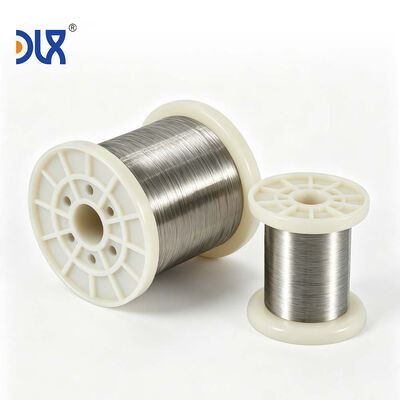
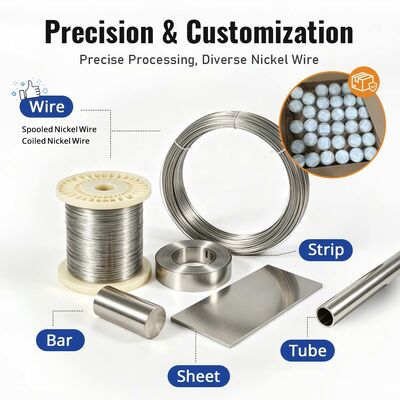
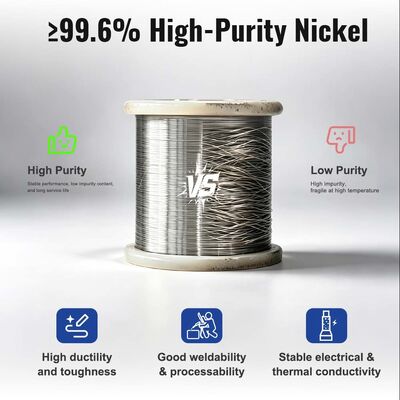


| Brand Name: | DLX |
| Model Number: | 0.025 Pure Nickel Wire |
| Payment Terms: | L/C,T/T,Western Union |
| Supply Ability: | 500 tons per month |
At 0.025 mm, a plated coating stops being protection and becomes a liability: the coating is a large share of the cross-section, and the moment it wears or delaminates, the exposed core corrodes fast and the wire fails. This solid pure nickel wire carries its corrosion resistance through the entire cross-section — there is no layer to lose. Drawn to ±0.003 mm from ≥99.5% nickel (N6), annealed for ≥35% elongation, and salt-spray tested on production batches, it keeps fine heating, sensing and instrumentation elements alive in salt-laden and chemically aggressive service.
| Diameter | Tolerance | Typical delivery form |
|---|---|---|
| 0.025 mm (ultra-fine) | ±0.003 mm | Spool, continuous length |
| 0.05–0.5 mm | per drawing | Spool, continuous length |
| 0.5–10 mm | per drawing | Coil, continuous length |
Diameter verified by laser gauge across every spool; tolerance on diameters above 0.05 mm is confirmed per drawing before production.
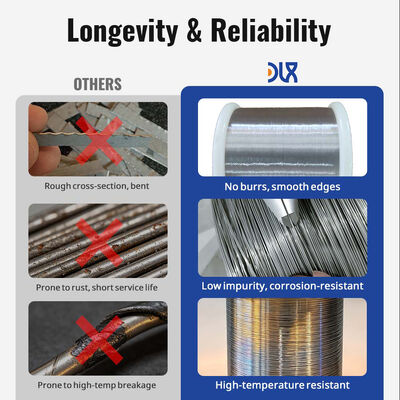
On 0.025 mm wire, a plated layer is a meaningful fraction of the cross-section. Plating wears, scratches and delaminates at cut ends; once the substrate is exposed, corrosion accelerates at the very points the coating was meant to protect. Solid nickel has no coating boundary — corrosion resistance is uniform from surface to centre.
| Factor | Solid nickel wire | Plated wire |
|---|---|---|
| Protection mechanism | Passive film on base metal, self-healing | Coating layer, finite life |
| Cut ends / weld points | Still corrosion resistant | Substrate exposed, corrodes |
| Cross-section share at 0.025 mm | 100% corrosion resistant | Coating dominates; failure when worn |
| Long-term impedance | Stable | Drifts as corrosion products form |
Fine wire fails by specific corrosion mechanisms; each has a known countermeasure in the nickel family:
| Corrosion type | Attack path | Nickel countermeasure |
|---|---|---|
| Pitting (chlorides, salt spray) | Impurity sites initiate pits | High purity — N4/N6 minimize initiation sites |
| Intergranular (after welding) | Carbide precipitation at grain boundaries | Low carbon — Ni201 (C ≤0.02%) |
| Uniform corrosion | Surface dissolution in aggressive media | Stable passive film, re-forms after damage |
| Creep corrosion / humidity | Dew-point electrochemical attack | Passivated surface option available |
Corrosion claims are tested, not assumed. Production batches are sampled for ASTM B117 salt-spray performance alongside tensile and hardness checks, and every heat is composition-tested against grade limits.
| Verification step | Detail |
|---|---|
| Chemistry | Composition per heat, locked against N6 limits |
| Salt-spray (ASTM B117) | Production batch sampling |
| Diameter | Laser gauge, 100% of spools |
| Documentation | EN 10204 3.1 MTC on request |
| Grade | Ni Content | Best Application | Reference Price (FOB, USD/kg) |
|---|---|---|---|
| N4 (NP1) | ≥99.9% | Vacuum electronics | 420–480 |
| Ni201 | ≥99.0% | High-temp service | 350–390 |
| Ni200 | ≥99.2% | Battery, chemical | 340–380 |
| N6 (NP2) | ≥99.5% | Industrial corrosion | 300–340 |
FOB China port, subject to spool size and quantity. Final quotation per drawing.
Source: DLX product catalogue, pure nickel family (grades N4 / N6 / Ni200 / Ni201).
| Element (wt%) | N4 | N6 | Ni201 | Ni200 |
|---|---|---|---|---|
| Ni+Co | 99.9 | 99.5 | — | — |
| Ni | — | — | ≥99.0 | ≥99.2 |
| C | ≤0.01 | ≤0.10 | ≤0.02 | ≤0.15 |
| Cu | ≤0.015 | ≤0.10 | ≤0.25 | ≤0.25 |
| Si | ≤0.03 | ≤0.10 | ≤0.35 | ≤0.35 |
| Mn | ≤0.002 | ≤0.05 | ≤0.35 | ≤0.35 |
| Fe | ≤0.04 | ≤0.10 | ≤0.40 | ≤0.40 |
| S | ≤0.001 | ≤0.005 | ≤0.01 | ≤0.01 |
| P | ≤0.001 | ≤0.002 | — | — |
| Mg | ≤0.01 | ≤0.10 | — | — |
| Property | Value |
|---|---|
| Density | 8.908 g/cm³ |
| Melting point | 1435–1446 °C |
| Curie temperature | 358 °C |
| Tensile strength (annealed) | ≥462 MPa |
| Elongation (annealed) | ≥35% |
| Hardness (annealed) | 90–120 HB |
| Shear modulus | ≈76 GPa |
| Electrical resistivity | 0.096 μΩ·m (20 °C) |
| Thermal conductivity (Ni200) | 70.2 W/m·K |
| Item | Detail |
|---|---|
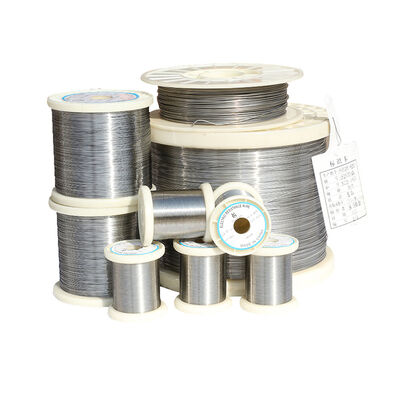
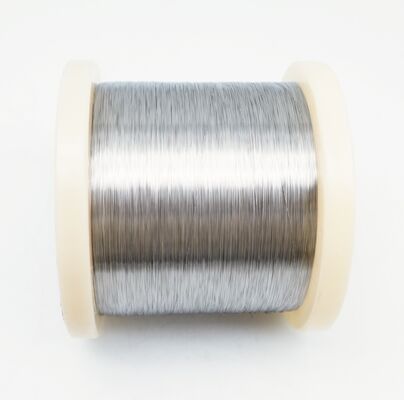
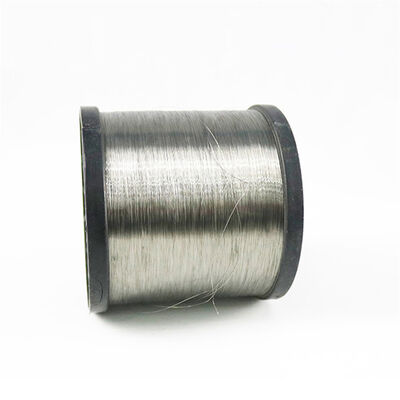
| Form | Solid fine wire on spool, continuous length |
| Diameter | 0.025 mm (ultra-fine); range to 10 mm |
| Temper | Annealed (M) / half-hard / hard |
| Surface | Clean, oxide-controlled; bright or matte |
| Spool weight | per drawing (0.025 mm: ≈229 m/kg) |
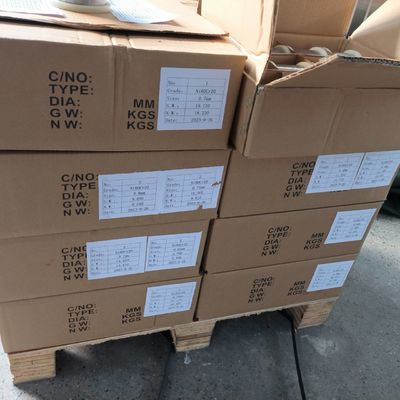
| Packaging | Plastic spool + moisture barrier + export carton |
Corrosion resistance is verified per batch, dimensions per spool. Production batches are sampled for ASTM B117 salt-spray performance, tensile, elongation and hardness; every spool is laser-gauged for diameter and ovality with surface inspection after annealing. Chemical composition is locked per heat, and an EN 10204 3.1 MTC is issued on request.
Wire is wound on plastic spools under controlled tension, wrapped in moisture barrier film and packed in export cartons; spool IDs and lot numbers trace back to the heat. Standard diameters ship in 7–15 days, custom drawing in 15–25 days. Free 0.5 kg samples are dispatched within 3–5 days.
Corrosion data is only as good as the lab behind it. Changzhou DLX Alloy operates its testing alongside production — composition analysis, tensile and hardness testing, and ASTM B117 salt-spray verification — inside a 12,000 m² nickel-only plant that has run since 2002. ISO9001 and SGS certified, 1,200 tonnes of annual capacity, and every spool traced back to the heat that made it: that is the verification chain behind a claim like "high corrosion resistance".
On 0.025 mm wire a plated layer is a large share of the cross-section and fails when it wears or delaminates, exposing the core. Solid nickel is corrosion resistant through the entire section — nothing to lose.
1 kg for 0.025 mm micro-wire — at ≈229 m/kg, one kilogram already covers a pilot run. Larger diameters follow the standard 5 kg MOQ.
Yes. Free 0.5 kg samples are available for N6 and Ni200 within 3–5 days; N4 and Ni201 samples are charged and refunded with your first order above 50 kg.
Production batches are sampled for ASTM B117 salt-spray performance, and an EN 10204 3.1 MTC with composition and mechanical results is issued on request.
Fine heating elements, sensors, fuse links and instrumentation in salt-laden, humid or chemically aggressive environments, where coating failure is not an option.


 english
 français
 Deutsch
 Italiano
 Русский
 Español
 português
 Nederlandse
 ελληνικά
 日本語
日本語
 한국
한국
 中文
中文
 العربية
 हिन्दी
 Türkçe
 indonesia
 tiếng Việt
 ไทย
ไทย
 বাংলা
বাংলা
 فارسی
فارسی
 polski
