5s
+1
Submission successful!

|
| Brand Name: | DLX |
| Model Number: | Pure Nickel Metal |
| MOQ: | 15kg |
| Payment Terms: | L/C,T/T,Western Union,VTB |
| Supply Ability: | 500 tons per month |
Wire breaks in two ways: it snaps when it can no longer deform, or it corrodes until the load-bearing section disappears. Both failures are written into the crystal structure before the wire is ever drawn. The face centered cubic lattice of pure nickel keeps 12 slip systems available for deformation — which is why this wire stretches ≥35% without work-hardening to fracture, and why it keeps its toughness at low temperature where body centered cubic metals turn brittle. Corrosion resistance completes the pair: a stable passive film that re-forms after surface damage, on wire from 0.025 mm to 10 mm, in stock for immediate shipment.
| Diameter | Tolerance | Typical delivery form |
|---|---|---|
| 0.025 mm (ultra-fine) | ±0.003 mm | Spool, continuous length |
| 0.05–0.5 mm | per drawing | Spool, continuous length |
| 0.5–10 mm | per drawing | Coil, continuous length |
Diameter verified by laser gauge across every spool; tolerance on diameters above 0.05 mm is confirmed per drawing before production.
Face centered cubic metals deform by slip on close-packed planes. With 12 active slip systems, an FCC wire redistributes strain instead of concentrating it — the mechanism behind annealed elongation of ≥35% and safe forming down to ultra-fine diameters.
| Property | FCC pure nickel | BCC metals (e.g. iron, steel) |
|---|---|---|
| Active slip systems | 12 — strain redistributes easily | Fewer effective — strain localizes |
| Ductile-to-brittle transition | None | Present at low temperature |
| Low-temperature toughness | Retained | Drops with temperature |
| Formability | High — drawing and winding friendly | Lower at fine diameters |
This is why nickel wire, not steel wire, is specified where fine diameters meet flexing, cold environments and corrosion together.
BCC metals lose impact toughness as temperature falls; FCC nickel does not. Pure nickel keeps its ductility at cryogenic temperatures, making FCC nickel wire a dependable choice for instrumentation and heating elements in cold-chain, LNG and refrigeration-adjacent equipment.
| Condition | Behaviour |
|---|---|
| Room temperature | ≥35% elongation, 90–120 HB annealed |
| Sub-zero service | FCC — toughness retained, no transition |
| Cyclic flexing | Slip distributes strain; work-hardening controlled by temper choice |
| Corrosive atmosphere | Passive film re-forms after surface damage |
Nickel's stable passive film resists industrial atmospheres, condensation and mild chemical exposure, while resistivity holds at 0.096 μΩ·m (20 °C) — predictable behaviour for heaters, sensors and fuse links that must not drift.
| Property | Value |
|---|---|
| Resistivity (20 °C) | 0.096 μΩ·m |
| Thermal conductivity | 70.2 W/m·K |
| Curie temperature | 358 °C |
| Melting point | 1435–1446 °C |
| Corrosion mode | Passive film, self-healing |
| Grade | Ni Content | Best Application | Reference Price (FOB, USD/kg) |
|---|---|---|---|
| N4 (NP1) | ≥99.9% | Vacuum electronics | 420–480 |
| Ni201 | ≥99.0% | High-temp service | 350–390 |
| Ni200 | ≥99.2% | Battery, chemical | 340–380 |
| N6 (NP2) | ≥99.5% | Industrial corrosion | 300–340 |
FOB China port, subject to spool size and quantity. Final quotation per drawing.
Source: DLX product catalogue, pure nickel family (grades N4 / N6 / Ni200 / Ni201).
| Element (wt%) | N4 | N6 | Ni201 | Ni200 |
|---|---|---|---|---|
| Ni+Co | 99.9 | 99.5 | — | — |
| Ni | — | — | ≥99.0 | ≥99.2 |
| C | ≤0.01 | ≤0.10 | ≤0.02 | ≤0.15 |
| Cu | ≤0.015 | ≤0.10 | ≤0.25 | ≤0.25 |
| Si | ≤0.03 | ≤0.10 | ≤0.35 | ≤0.35 |
| Mn | ≤0.002 | ≤0.05 | ≤0.35 | ≤0.35 |
| Fe | ≤0.04 | ≤0.10 | ≤0.40 | ≤0.40 |
| S | ≤0.001 | ≤0.005 | ≤0.01 | ≤0.01 |
| P | ≤0.001 | ≤0.002 | — | — |
| Mg | ≤0.01 | ≤0.10 | — | — |
| Property | Value |
|---|---|
| Density | 8.908 g/cm³ |
| Melting point | 1435–1446 °C |
| Curie temperature | 358 °C |
| Tensile strength (annealed) | ≥462 MPa |
| Elongation (annealed) | ≥35% |
| Hardness (annealed) | 90–120 HB |
| Shear modulus | ≈76 GPa |
| Electrical resistivity | 0.096 μΩ·m (20 °C) |
| Thermal conductivity (Ni200) | 70.2 W/m·K |
| Item | Detail |
|---|---|
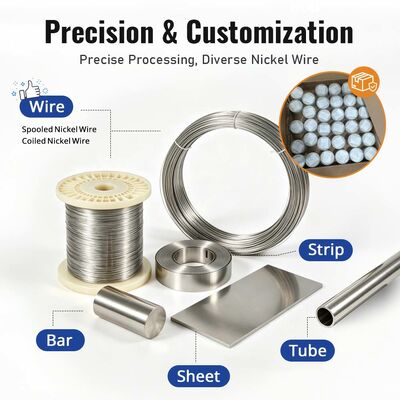
| Form | Fine wire on spool, continuous length |
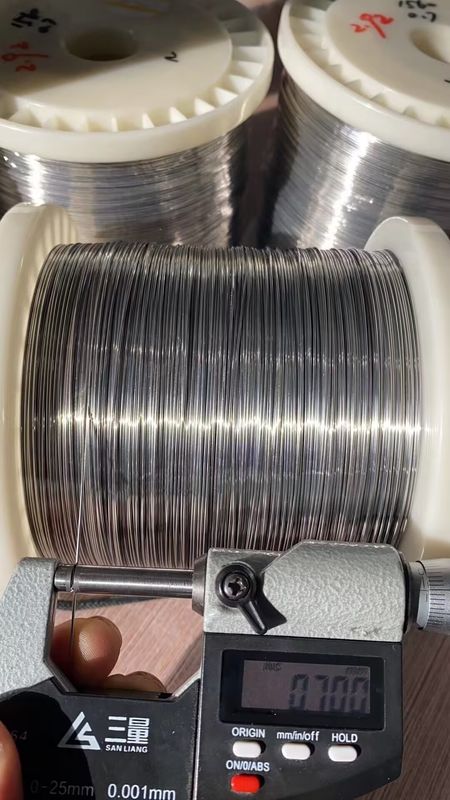
| Diameter | 0.025–10 mm |
| Crystal structure | FCC (face centered cubic) |
| Temper | Annealed (M) / half-hard / hard, per winding and forming process |
| Surface | Clean, oxide-controlled; bright or matte |
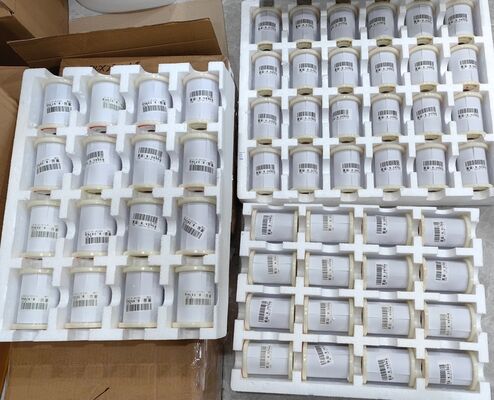
| Packaging | Plastic spool + moisture barrier + export carton |
Structure and chemistry are verified, not assumed. Every heat is composition-tested against grade limits; every spool is laser-gauged for diameter and ovality with surface inspection after annealing. Batches are sampled for tensile, elongation and hardness, and an EN 10204 3.1 MTC is issued on request.
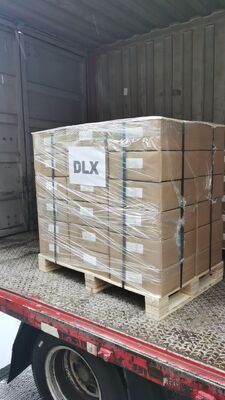
Wire is wound on plastic spools under controlled tension, wrapped in moisture barrier film and packed in export cartons; spool IDs and lot numbers trace back to the heat. Stock diameters ship in 3–7 days, custom drawing in 15–25 days. Free 0.5 kg samples are dispatched within 3–5 days.
Understanding the crystal structure is where DLX Alloy's engineering starts. Since 2002, our metallurgists have controlled melting, rolling, drawing and annealing inside a 12,000 m² nickel-only plant — managing grain size, temper and surface so the FCC lattice delivers what the datasheet promises. ISO9001 and SGS certified, 1,200 tonnes of annual capacity, and every spool traceable to its heat.
FCC nickel deforms through 12 slip systems, giving ≥35% elongation and no ductile-to-brittle transition — it flexes, winds and forms without brittle fracture, even at low temperatures.
Yes. FCC metals keep their toughness at sub-zero temperatures, unlike BCC steels — suitable for cold-chain, LNG-adjacent and refrigeration equipment.
MOQ is 5 kg. A free 0.5 kg sample is available for N6 and Ni200; N4 and Ni201 samples are charged and refunded with your first order above 50 kg.
0.025–10 mm across the pure nickel family; stock diameters ship in 3–7 days, custom drawing in 15–25 days.
Yes. EN 10204 3.1 MTC with full chemical composition and mechanical test results is available per batch.


 english
 français
 Deutsch
 Italiano
 Русский
 Español
 português
 Nederlandse
 ελληνικά
 日本語
日本語
 한국
한국
 中文
中文
 العربية
 हिन्दी
 Türkçe
 indonesia
 tiếng Việt
 ไทย
ไทย
 বাংলা
বাংলা
 فارسی
فارسی
 polski