
5s
+1
Submission successful!

|
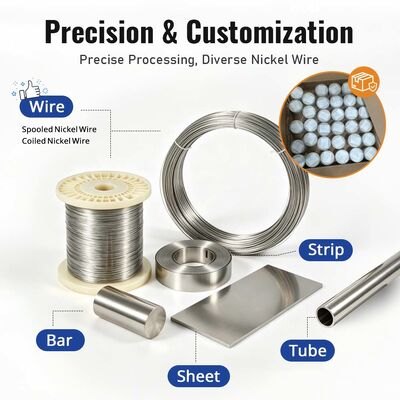
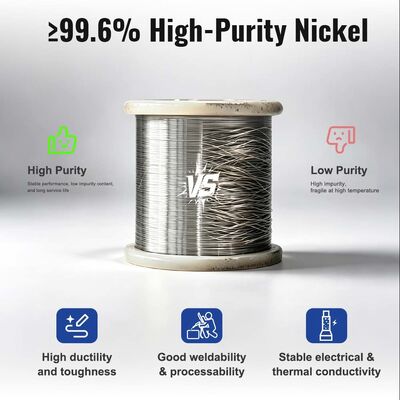
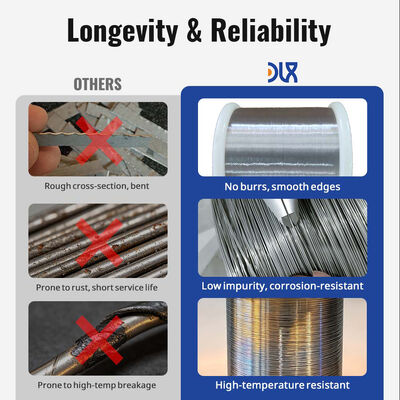


| Brand Name: | DLX |
| Model Number: | pure nickel wire |
| Price: | $20-$300/kg |
| Payment Terms: | L/C,T/T,Western Union |
| Supply Ability: | 500 tons per month |
Nickel-Only Factory | Since 2002 | Ni200/Ni201/N6 | 0.025–10mm | Oxidation-Resistant to 315°C+
A copper wire in a crimp terminal at 200°C fails not because the copper melts — it melts at 1085°C — but because the copper surface oxidizes. Copper oxide is a semiconductor. It grows as a film between the wire and the terminal wall, increasing contact resistance month by month until the connection overheats, oxidizes faster, and fails — a thermal runaway that begins with an oxide layer too thin to see. Pure nickel wire from Changzhou DLX Alloy Co., Ltd. solves this problem at the material level: nickel oxide grows orders of magnitude slower than copper oxide at any given temperature, is thinner, and — critically — remains electrically conductive enough that the connection resistance stays stable over years of elevated-temperature service. This is why nickel wire is specified for battery tabs, furnace terminal leads, high-temperature connectors, and any electrical joint that must survive where copper cannot. Full EN 10204 3.1 MTC traceability from ingot to spool on every shipment.
| Temperature | Copper Wire Behavior | Nickel Wire Behavior | Connection Consequence |
|---|---|---|---|
| 100°C | Thin Cu₂O film forms over days — slight discoloration. Contact resistance essentially unchanged. | No visible oxidation. Contact resistance unchanged. | Both materials acceptable. Copper is lower cost and more conductive — preferred below 100°C. |
| 150°C | CuO begins to form over Cu₂O. Film thickness grows to tens of nanometers over weeks. Contact resistance increases measurably — typical 2–5 mΩ increase at a crimp terminal after 1,000 hours. | NiO film begins to form — but growth rate is approximately 1/10th of copper oxide at the same temperature. Contact resistance change negligible after 1,000 hours. | Copper connections begin to degrade. In a high-current application (>10A), the increased resistance generates additional I²R heating — accelerating further oxidation. Nickel connections remain stable. |
| 200°C | CuO film grows rapidly — visible blackening of the wire surface within hours. At a crimp terminal, the oxide layer between the wire strands and the terminal barrel increases contact resistance by 10–50 mΩ over 500 hours. The increased resistance generates heat — the connection temperature rises above ambient — oxidation accelerates — thermal runaway begins. | NiO film remains thin and adherent. Green-grey coloration of the wire surface is cosmetic — the underlying nickel is protected. Contact resistance increase <2 mΩ after 2,000 hours at 200°C. No thermal runaway. | Copper connections fail progressively — the failure mode is a fire risk in high-power applications. Nickel connections remain stable — the oxide is self-limiting and does not progressively degrade the contact. |
| 315°C | Copper wire is no longer functionally usable in air. Oxide scale spalls off — exposing fresh copper that oxidizes immediately. Wire cross-section progressively consumed. Connection resistance unstable and increasing. Typical service life: <500 hours. | Maximum continuous service temperature for Ni200 in air. NiO scale is protective — it grows to a limiting thickness and essentially stops. Wire cross-section preserved. Connection resistance stable. Service life: >10,000 hours. | This is the temperature boundary where nickel wire becomes the only practical choice for bare (unplated) conductors in air. Above 315°C, Ni201 is specified to avoid graphitization embrittlement. |
| 500°C | Copper wire is destroyed — rapid oxidation consumes the wire cross-section within hours. Not usable. | Ni201 (low carbon) continues to function. Oxidation rate increases but remains protective. Wire maintains mechanical integrity. Suitable for furnace terminal leads, heating element connections, and thermocouple extension wire. | Nickel wire is the standard material for high-temperature electrical connections — not because it is the best conductor, but because it is the only bare conductor that survives. |
| Connection Type | What Happens at Temperature | Why Nickel Wire Is Specified | Typical Application |
|---|---|---|---|
| Crimped terminal | Wire strands are compressed inside a metal barrel. Gas-tight cold weld forms at the wire-to-barrel interface. At temperature, differential thermal expansion between nickel wire and copper terminal creates micro-movement — the gas-tight seal can be broken, allowing oxidation at the interface. | Nickel wire's self-limiting oxide means that even if the gas-tight seal is breached, the oxide that forms is thin and conductive — the connection does not degrade. With copper wire, a breached seal leads to progressive CuO formation and connection failure. | Furnace power leads, industrial heater terminations, high-temperature sensor connectors |
| Resistance-welded tab | Nickel wire is resistance-welded to a nickel or nickel-plated tab. The weld forms a metallurgical bond — no interface, no oxidation path. At temperature, the nickel-to-nickel bond has zero differential expansion. | Nickel wire to nickel tab = monometallic joint. No galvanic corrosion. No differential thermal expansion. No dissimilar metal interdiffusion. The joint is as thermally stable as the wire itself. | Battery pack tab welding (18650, 21700, prismatic cells), busbar connections, power semiconductor lead attachment |
| Screw-clamped terminal block | Wire is compressed under a screw. The contact area is smaller than a crimp and more susceptible to oxidation. Thermal cycling loosens the screw — contact pressure decreases — oxidation accelerates. | Nickel wire tolerates reduced contact pressure better than copper because the oxide that forms is thinner and more conductive. A nickel connection that has loosened slightly still conducts — a copper connection in the same condition may fail open-circuit. | Industrial furnace terminal blocks, heater connection boxes, high-temperature junction boxes |
| Spring-loaded contact | A spring finger presses against the wire surface. Contact force is low — typically 1–5 N. The interface is not gas-tight. Oxidation is inevitable at temperature. | Nickel wire is the material of choice for spring-loaded high-temperature contacts. The self-limiting oxide film is thin enough that the spring force can mechanically penetrate it on each make-break cycle — restoring a low-resistance metal-to-metal contact. Copper oxide is too thick and too resistive for this mechanism to work reliably. | Thermocouple connectors, quick-disconnect high-temperature sensor leads, battery pack contact plates |
Changzhou DLX Alloy Co., Ltd. has drawn pure nickel wire for over two decades. Battery manufacturers buy our wire for interconnects because it welds cleanly and does not corrode. RTD sensor manufacturers buy our wire because the TCR is predictable and the resistance-per-meter is consistent. Relay manufacturers buy our wire because it maintains contact force through millions of cycles. Each of these customers taught us what matters for electrical-grade nickel wire — and the answer is always the same: consistency. Consistent chemistry produces consistent TCR. Consistent diameter produces consistent resistance per meter. Consistent annealing produces consistent mechanical properties. Consistent surface cleanliness produces consistent weld quality. Consistency is not achieved by inspection — it is achieved by controlling the process from ingot to spool. That is what a nickel-only facility with integrated melting, drawing, and annealing makes possible.
Chemistry certified from ingot through finished wire. For electrical applications, Ni content, Fe content, and trace elements determine TCR, resistivity, and thermal EMF stability.
| Wire Diameter | 0.025–10 mm standard; custom diameters on request |
| Diameter Tolerance | Standard cold-drawn per diameter. Precision tolerance available for RTD sensor wire where resistance-per-meter must be tightly controlled. |
| Available Grades | N4 (precision TCR), N6 (standard electrical), Ni200, Ni201 (high-temp electrical) |
| Delivery Condition | Soft annealed — bright finish (standard). Hard drawn on request for applications requiring higher tensile strength. |
| Surface Finish | Bright — hydrogen annealed, no surface oxide, no pickling. Ready for welding, soldering, or crimping directly from the spool. |
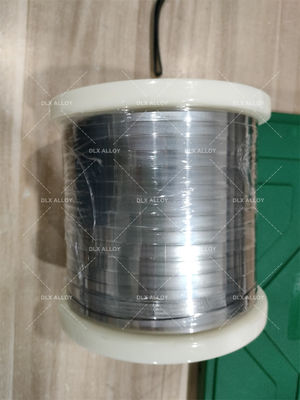
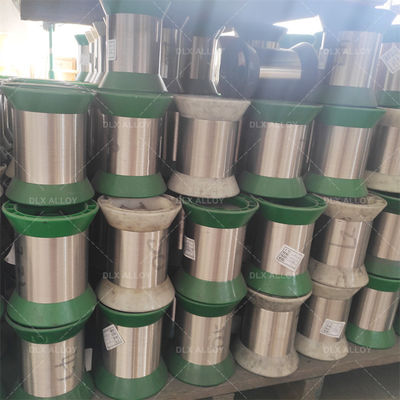
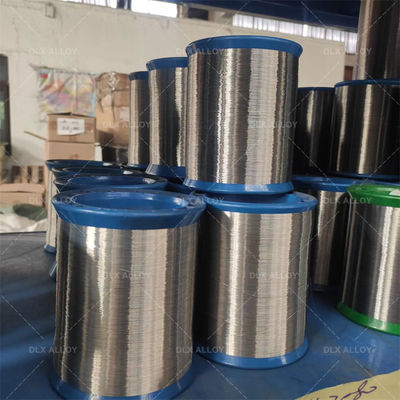
| Packaging | Spooled on plastic or wooden reels with controlled tension. Vacuum-sealed with desiccant — surface remains bright and oxide-free. |
| Testing (standard) | OES chemistry per ingot. Diameter per spool. Tensile per lot. Surface inspection per spool. |
| Testing (electrical — on request) | Resistance-per-meter measurement. TCR calculation from chemistry or direct TCR measurement. Thermal EMF certification (thermocouple-grade). |
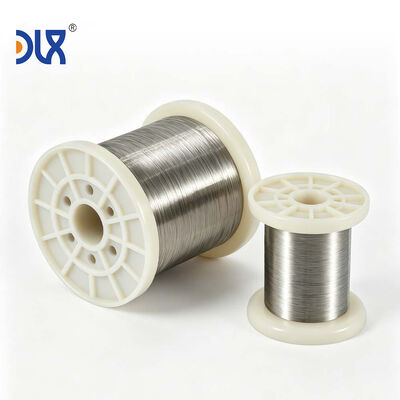
| Spool types | Plastic reels (D55–D400) or wooden reels. Precision layer-wound with controlled back-tension — uniform dereeling force from full spool to empty. |
| Surface protection | Vacuum-sealed with desiccant and humidity indicator card immediately after final inspection. Barrier film with aluminum layer. Surface remains bright and oxide-free for minimum 24 months in sealed packaging. |
| Identification | Grade, heat number, diameter, net weight, spool number, DLX traceability code on every spool label. Resistance-per-meter data included where requested. |
| Documentation | EN 10204 3.1 MTC with complete chemistry + diameter record + certificate of conformance + packing list. TCR data, resistance-per-meter data, and thermal EMF cert available on request. |
| Sample MOQ | 5 kg per diameter — free for electrical performance evaluation. Test our TCR consistency and weldability in your specific application. |
| Production MOQ | 30 kg per diameter. Scheduled deliveries available for production lines. |
| Lead Time | 3–7 days for stock diameters; 15–25 days for custom diameters or N4 precision TCR grade. |
| Shipping | Air (DHL, FedEx) for trial; sea (FCL/LCL) for production. |
| Payment | T/T for trial; T/T or L/C at sight for production. |


 english
 français
 Deutsch
 Italiano
 Русский
 Español
 português
 Nederlandse
 ελληνικά
 日本語
日本語
 한국
한국
 中文
中文
 العربية
 हिन्दी
 Türkçe
 indonesia
 tiếng Việt
 ไทย
ไทย
 বাংলা
বাংলা
 فارسی
فارسی
 polski
