
5s
+1
Submission successful!

|

| Brand Name: | DLX |
| Model Number: | pure nickel wire |
| MOQ: | 1kg |
| Price: | $20-$300/kg |
| Payment Terms: | L/C,T/T,Western Union |
| Supply Ability: | 500 tons per month |
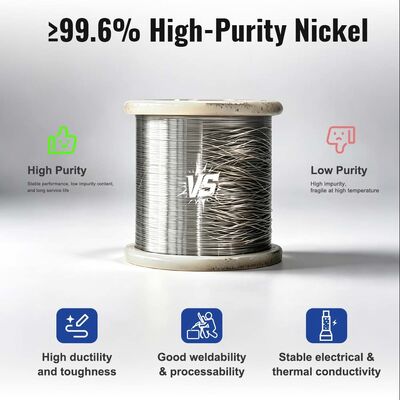
ISO9001 Factory Direct | Since 2002 | N4/N6/Ni200/Ni201 | 0.025–10mm | MP 1435–1446°C
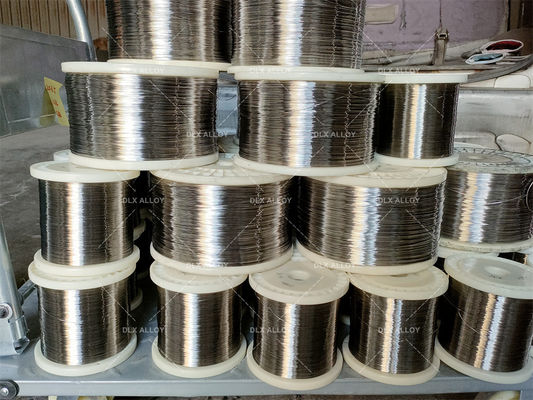
Pure nickel wire from Changzhou DLX Alloy Co., Ltd. bridges a critical gap in the high-temperature materials spectrum — above the useful limit of copper and below the cost threshold of platinum. With a melting point of 1435–1446°C and reliable service to 315°C for Ni200 or well above for the low-carbon Ni201 variant, our pure nickel wire resists oxidation, maintains ductility through thermal cycling, and provides the thermal and electrical conductivity stability required in furnace heating elements, thermocouple conductors, chemical process sensors, and vacuum tube components. Manufactured from our own ingot through multi-pass precision drawing and controlled-atmosphere bright annealing, every spool is traceable to melt chemistry with full EN 10204 3.1 MTC documentation.
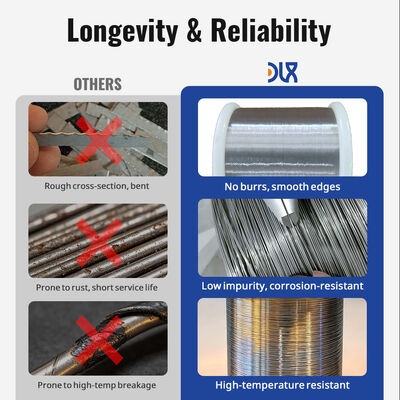
Pure nickel alloy is a high-quality metal material widely utilized for its outstanding physical and chemical properties. Comprising predominantly of high-purity nickel, this alloy typically contains minimal amounts of other alloying elements to enhance its performance. Pure nickel alloy boasts excellent conductivity, corrosion resistance, and high-temperature endurance, making it an ideal choice across various industrial sectors.
This alloy finds application in the electronics industry for manufacturing efficient electronic components such as connectors and wires, ensuring reliable electrical performance. In the chemical and petroleum industries, pure nickel alloy is extensively used in corrosion-resistant and high-temperature equipment, including chemical reactors and pipeline systems. In the aerospace sector, it is employed in the production of high-temperature alloys and critical components to withstand extreme environmental conditions.
Furthermore, pure nickel alloy plays a crucial role in light bulb manufacturing, artificial joints, precision instruments, and welding. Its exceptional mechanical properties and biocompatibility make it an ideal material for artificial joints, while in welding, pure nickel alloy provides excellent corrosion resistance and high-temperature stability.
Overall, the multifunctional properties of pure nickel alloy make it an indispensable material across various industries, offering reliable solutions for diverse applications.

| Grade | Chemical Composition(%) | ||||||||
| Ni+Co | Cu | Si | Mn | C | Mg | S | P | Fe | |
| N4/201 | 99.9 | ≤0.015 | ≤0.03 | ≤0.002 | ≤0.01 | ≤0.01 | ≤0.001 | ≤0.001 | ≤0.04 |
| N6/200 | 99.5 | 0.1 | 0.1 | 0.05 | 0.1 | 0.1 | 0.005 | 0.002 | 0.1 |
Ni200 and Ni201 are chemically identical in nickel content — both ≥99.0% minimum. The difference is carbon: Ni200 allows up to 0.15% carbon. Ni201 limits carbon to ≤0.02%. At room temperature, this difference is metallurgically invisible. At 315°C and above, it determines whether the wire survives.
In Ni200 with 0.10% carbon, exposure to temperatures above 315°C causes carbon to diffuse to grain boundaries where it precipitates as graphite. These graphite particles are not just microstructural features — they are physical voids that decohere the grain boundaries. The wire loses ductility. Under thermal cycling, grain boundary cracks initiate at the graphite particles and propagate. After hundreds of hours above 400°C, Ni200 can become brittle enough to fracture under its own weight during handling — a phenomenon known as graphitization embrittlement.
Ni201, with carbon ≤0.02%, contains too little carbon to form continuous graphite films at grain boundaries. The wire retains its ductility after extended high-temperature exposure. It can be bent, coiled, and handled after thousands of hours at 500°C without fracturing. This is why Ni201 exists — not as a higher-purity upgrade, but as a fundamentally different metallurgical solution for sustained elevated-temperature service.
| Property | Ni200 | Ni201 | Implication for High-Temperature Use |
|---|---|---|---|
| Nickel content | ≥99.0% | ≥99.0% | Identical — no difference in corrosion resistance or electrical properties |
| Carbon content | ≤0.15% | ≤0.02% | Critical — the sole parameter that determines high-temperature suitability above 315°C |
| Max service temperature (continuous) | 315°C | 600°C+ in non-oxidizing atmosphere | Ni201 survives where Ni200 embrittles. Below 315°C, both perform identically. |
| Post-exposure ductility | Degrades above 315°C — graphitization embrittlement | Retained after extended exposure above 315°C | If the wire must be handled, bent, or re-terminated after high-temperature service, Ni201 is specified. |
| Oxidation resistance | Good to 315°C; progressive oxidation above | Good to 315°C; progressive oxidation above — essentially identical to Ni200 | Oxidation rate is determined by temperature and atmosphere, not carbon content. Both grades oxidize above 315°C in air. |
| Cost differential | Standard grade — lower cost | Premium — higher cost from tighter carbon control during melting | For applications below 315°C, Ni200 is the economical choice. Above 315°C, the cost of a Ni200 wire failure exceeds the Ni201 premium. |
| Application | Temperature Range | Recommended Grade | Why Pure Nickel Wire |
|---|---|---|---|
| Thermocouple extension wire (Type K, Type T) | −200 to 400°C (Ni200), −200 to 600°C (Ni201) | Ni200 for general purpose; Ni201 for high-temp leg | Thermal EMF stability requires consistent chemistry. Our ingot-to-wire traceability ensures the EMF characteristics match the thermocouple calibration curve — heat to heat, spool to spool. |
| Vacuum tube & electron tube components | 400–900°C during outgassing, lower during operation | N4 or Ni201 | Low vapor pressure at high temperature — nickel does not evaporate and redeposit on tube insulators. High purity (N4) minimizes trace element vaporization that can poison the cathode. |
| Electrical resistance thermometers (RTD leads) | −200 to 500°C | Ni201 | Predictable and stable resistance-temperature relationship. Ni201 avoids carbon-induced resistance drift from graphitization at the upper end of the temperature range. |
| Furnace heating element leads | 300–700°C at the cold-end termination | Ni201 | Connects the high-temperature NiCr heating element to the lower-temperature copper power cable. Must survive the thermal gradient without embrittlement. Ni201's low carbon prevents brittle failure at the transition zone. |
| Chemical process sensor sheaths & conductors | 200–500°C in caustic or neutral environments | Ni201 | Resists caustic stress corrosion cracking that destroys stainless sensor sheaths. Ni201 survives where 316L cracks within hours in hot concentrated NaOH. |
| Semiconductor & crystal growth furnace leads | 400–800°C in vacuum or inert atmosphere | N4 | Ultra-high purity with Fe ≤0.04% prevents silicon wafer contamination from trace metal vaporization. Required for semiconductor-grade furnace environments. |
Changzhou DLX Alloy Co., Ltd. has manufactured nickel wire since 2002. Over two decades, we have supplied pure nickel wire to furnace builders who stake their reputation on element life, to thermocouple manufacturers whose calibration certificates depend on wire consistency, and to vacuum tube fabricators who cannot tolerate parts-per-million contamination. Each of these customers taught us something about what matters in high-temperature nickel wire — and each lesson refined our process.
The critical lesson is this: at high temperature, the wire fails not because the nickel was defective, but because a process variable — carbon in the melt, oxygen in the annealing atmosphere, iron on the die surface — was slightly out of control. High-temperature performance is not a material property; it is a process control achievement. Our nickel-only facility, our in-house melting, our controlled-atmosphere annealing, and our full traceability from ingot to spool are the process controls that produce wire that survives at temperature — batch after batch, year after year.
Chemistry certified from ingot through finished wire. Carbon content verified for every Ni201 heat — the single parameter that defines high-temperature suitability.
| Element (%) | N4 | N6 | Ni200 | Ni201 |
|---|---|---|---|---|
| Ni+Co | ≥99.9 | ≥99.5 | — | — |
| Ni | — | — | ≥99.0 | ≥99.0 |
| C | ≤0.01 | ≤0.1 | ≤0.15 | ≤0.02 |
| Fe | ≤0.04 | ≤0.1 | ≤0.4 | ≤0.4 |
| Cu | ≤0.015 | ≤0.1 | ≤0.25 | ≤0.25 |
| Si | ≤0.03 | ≤0.1 | ≤0.35 | ≤0.35 |
| Mn | ≤0.002 | ≤0.05 | ≤0.35 | ≤0.35 |
| S | ≤0.001 | ≤0.005 | ≤0.01 | ≤0.01 |
Carbon is the key differentiator for high-temperature applications. Ni201 with C ≤0.02% survives above 315°C without graphitization embrittlement. Ni200 below 315°C performs identically at lower cost. N4 and N6 provide progressively higher purity for applications where trace element control is critical.
| Property | Value |
|---|---|
| Melting Point | 1435–1446°C |
| Density | 8.89 g/cm³ |
| Thermal Conductivity (20°C) | 70 W/m·K |
| Electrical Resistivity (20°C) | ~0.096 μΩ·m (annealed) |
| TCR (20–100°C) | ~6000 × 10⁻⁶ /°C |
| Curie Temperature | ~358°C |
| Ni200 Max Service (continuous) | 315°C in air |
| Ni201 Max Service (continuous) | >600°C — atmosphere dependent |
| Wire Diameter | 0.025–10 mm standard; custom diameters on request |
| Available Grades | N4, N6, Ni200, Ni201 |
| Delivery Condition | Soft annealed (bright), hard drawn — specify when ordering |
| Surface Finish | Bright annealed (standard), oxide, coated |
| Tolerance | Standard cold-drawn tolerance per diameter; tighter tolerances available |
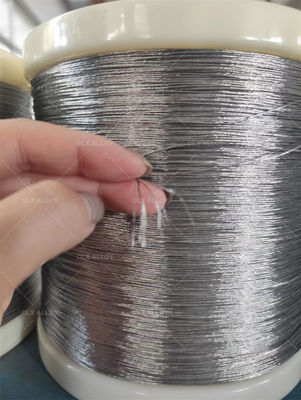
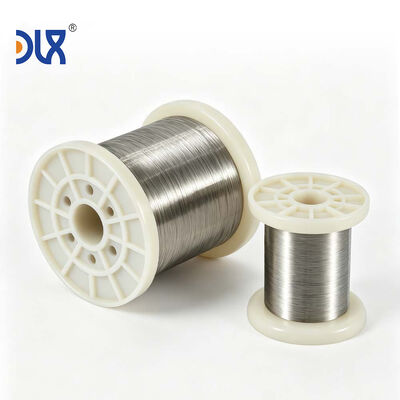
| Packaging | Spooled on plastic or wooden reels; vacuum-sealed with desiccant |
| Applicable Standards | ASTM B160, GB/T 5235, thermocouple EMF standards per IEC 60584 |
| Testing | OES chemical analysis, tensile, diameter inspection, surface quality; thermal EMF on request |
| Control Point | Verification | High-Temperature Relevance |
|---|---|---|
| Carbon content (melt) | Combustion analysis per ingot. Ni201 heats: C verified ≤0.02%, typically ≤0.01%. | Carbon above 0.02% = graphitization embrittlement above 315°C. The single most important quality parameter for high-temperature nickel wire. |
| Full chemistry (melt) | OES per ingot — Fe, Cu, Si, Mn, S verified against grade specification. | Trace elements affect oxidation rate, thermal EMF, and ductility at temperature. Consistent chemistry = consistent high-temperature performance. |
| Annealing atmosphere | Continuous dew point monitoring. Hydrogen or dissociated ammonia — oxygen content verified below threshold for nickel oxidation at annealing temperature. | Surface oxidation during annealing depletes the wire surface of nickel — leaving a nickel-oxide scale that must be removed by pickling. Pickling damages the surface. Bright annealing avoids this entirely. |
| Surface condition | Visual at 5× per spool. Water break test — verifies no residual drawing lubricant. | Surface contamination vaporizes at high temperature — contaminating furnace atmospheres or vacuum environments. Clean surface = clean high-temperature operation. |
| Diameter | Laser micrometer — in-line during drawing; final verification per spool. | Diameter variation = resistance variation = temperature variation in heating applications. Consistent diameter across the spool. |
| Thermal EMF (thermocouple-grade) | Measured against platinum reference at specified temperature points. Deviation from standard table recorded. | Thermocouple accuracy depends on wire EMF matching the calibration standard. Wire that fails EMF tolerance is not shipped as thermocouple-grade. |
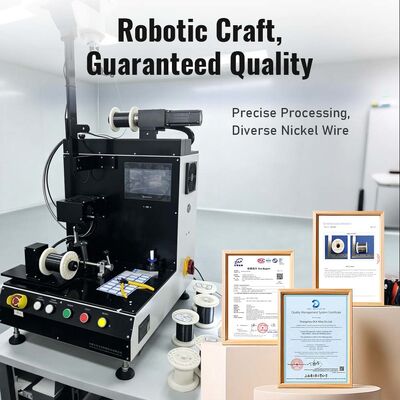
Third-party verification by SGS, BV, or TÜV. Free sample available for high-temperature performance evaluation. Full documentation package with every shipment.
| Spool types | Plastic reels (D55–D400) or wooden reels per customer specification. Ultra-fine wire (≤0.05mm) on precision bobbins with controlled tension winding. |
| Surface protection | Vacuum-sealed with desiccant immediately after final inspection. Surface remains bright and oxidation-free from our spooler to your process — critical for high-temperature applications where surface oxidation during storage creates a starting defect. |
| Identification | Grade, heat number, carbon content (for Ni201), diameter, net weight, spool number, DLX traceability code on every spool label and packing list. |
| MOQ | 5 kg per diameter for ultra-fine wire (<0.1mm); 30 kg for standard sizes. Trial quantities supported. |
| Lead Time | 3–7 days for stock diameters; 15–25 days for custom diameters or Ni201 with specified low-carbon heat selection. |
| Shipping | Air (DHL, FedEx) for trial and urgent orders; sea (FCL/LCL) for production volumes. |
| Payment | T/T for trial; T/T or L/C at sight for production. |
At 450°C, Ni200 will experience graphitization embrittlement. The wire will lose ductility progressively — after approximately 500–1,000 hours, it may become brittle enough to fracture under mechanical load or thermal cycling. If your wire is installed once and never disturbed — embedded in a furnace wall, for example — embrittlement may be acceptable. If the wire must survive handling, vibration, or thermal expansion/contraction cycles — which is nearly all real-world installations — Ni201 is required. The cost difference is approximately 10–20% for the wire. The cost of a field failure at 450°C is orders of magnitude higher.
We test every ingot for carbon by combustion analysis — the reference method for carbon determination in nickel. The result appears on the EN 10204 3.1 MTC that ships with your wire. If you require independent verification, we can supply a sample from your production lot for third-party carbon analysis at a laboratory of your choice. This is standard practice for customers in nuclear, aerospace, and vacuum furnace applications where carbon content is a safety-critical parameter.
Oxidation, not melting, is the limiting factor. Pure nickel oxidizes progressively in air above approximately 315°C — forming a green-black nickel oxide scale. The oxidation rate doubles roughly every 50–100°C increase. At 800°C, a 1 mm diameter wire will oxidize completely through in tens to hundreds of hours. For continuous service in air above 600°C, nickel-chromium alloys (NiCr) are preferred because the chromium forms a protective Cr₂O₃ scale that slows further oxidation. Pure nickel is best in reducing, neutral, or vacuum atmospheres at high temperature, or in air at temperatures below approximately 500°C where the oxidation rate is manageable for the intended service life. At DLX, we manufacture both pure nickel and NiCr wires — we can recommend the appropriate alloy for your temperature and atmosphere.
Yes. For Type K and Type T thermocouple extension wire, we can supply nickel wire with thermal EMF measured against a calibrated platinum reference at specified temperature points. The deviation from the IEC 60584 standard table is recorded on the certificate. Wire that does not meet the specified EMF tolerance is not shipped as thermocouple-grade. Specify your required EMF tolerance and temperature range when ordering.
N4 provides higher purity (Ni+Co ≥99.9% vs ≥99.0% for Ni201) with significantly lower iron (≤0.04% vs ≤0.4%). In semiconductor crystal growth furnaces operating at 800°C in vacuum, trace iron in the nickel wire can vaporize and deposit on the silicon wafer — creating defects that reduce yield. N4's 10× lower iron content proportionally reduces this contamination risk. N4 also has low carbon (≤0.01%) — providing the same high-temperature graphitization resistance as Ni201. For semiconductor applications where wafer contamination is the primary concern, N4 is specified. For general high-temperature applications where carbon embrittlement is the primary concern, Ni201 is the economical choice.


 english
 français
 Deutsch
 Italiano
 Русский
 Español
 português
 Nederlandse
 ελληνικά
 日本語
日本語
 한국
한국
 中文
中文
 العربية
 हिन्दी
 Türkçe
 indonesia
 tiếng Việt
 ไทย
ไทย
 বাংলা
বাংলা
 فارسی
فارسی
 polski