
5s
+1
Submission successful!
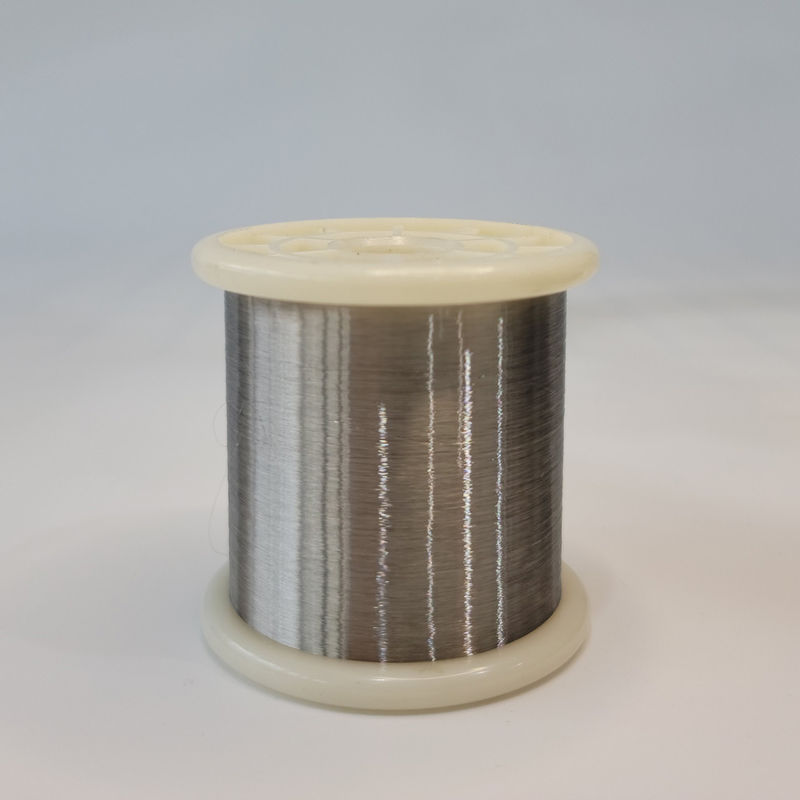
|
| Brand Name: | DLX |
| Model Number: | CuNi Alloy |
| Payment Terms: | L/C,T/T,Western Union |
| Supply Ability: | 500 tons per month |
CuNi alloy wire from Changzhou DLX Alloy Co., Ltd. — with 23% nickel content — delivers excellent and stable electrical resistivity of 0.12 μΩ·m at 20°C combined with a low temperature coefficient of resistance (TCR) of 50*10⁻⁶/°C. Available in both hard and soft temper to match your forming and electrical performance requirements, our CuNi23 wire is manufactured through precision melting, multi-pass cold drawing, and controlled-atmosphere annealing for uniform diameter, consistent resistivity, and reliable thermoelectric performance. Widely used in precision resistors, heating cables, thermal overload relays, low-resistance circuit breakers, and electrical appliance components. Full EN 10204 3.1 MTC traceability on every spool.

| Property | Value |
|---|---|
| Nominal Composition | Cu balance, Ni 23% |
| Resistivity at 20°C | 0.12 μΩ·m |
| TCR (20–600°C) | 50 * 10⁻⁶ /°C |
| Tensile Strength | ≥350 MPa |
| Melting Point | ~1150°C |
| Density | ~8.9 g/cm³ |
| EMF vs Copper (0–100°C) | −34 μV/°C |
| Max Working Temperature | 300°C |
| Characteristic | Hard Temper (Cold Drawn) | Soft Temper (Annealed) |
|---|---|---|
| Tensile Strength | Higher — up to ~550 MPa | Lower — ~350 MPa minimum |
| Elongation | Lower — typically 1–5% | Higher — ≥25% |
| Resistivity | Stable — 0.12 μΩ·m | Stable — 0.12 μΩ·m (resistivity independent of temper) |
| Formability | Limited — suitable for straight sections, minimal bending | Excellent — suitable for coiling, winding, complex forming |
| Best For | Straight heating elements, rigid resistor leads, structural applications where stiffness is needed | Coiled heating cables, wound resistors, thermal overload relay windings, applications requiring post-forming |
Hard or soft? Hard temper delivers higher mechanical strength and stiffness — ideal for self-supporting elements. Soft temper provides maximum formability for winding and coiling operations. Electrical resistivity is consistent in both conditions. Not sure? Tell us your forming process — we recommend within 24 hours.
| Advantage | How CuNi23 Delivers | Benefit vs Alternatives |
|---|---|---|
| Stable resistivity | Copper-nickel solid solution alloy — resistivity is inherent to the composition, not dependent on cold work or heat treatment | Unlike pure nickel or NiCr alloys where resistivity varies with processing history, CuNi23 maintains consistent 0.12 μΩ·m in both hard and soft conditions |
| Low TCR — minimal resistance drift with temperature | TCR of 50*10⁻⁶/°C means resistance changes only ~0.5% per 100°C temperature change | Pure metals (Cu: ~4000, Ni: ~6000) drift 80–120* more with temperature. Your precision resistor or relay stays calibrated across operating temperature range |
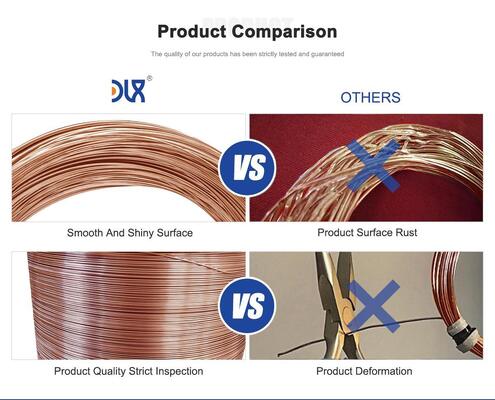
| Excellent corrosion resistance | 23% nickel content provides good resistance to oxidation, moisture, and many chemical environments | Outlasts bare copper and copper-clad wires in humid, mildly corrosive, or elevated-temperature environments — no protective coating required for most applications |
| Good processability & weldability | Ductile solid solution alloy — readily cold drawn to fine diameters, easily soldered and welded | Simplifies your manufacturing: no special joining techniques, no brittle intermetallic concerns, standard soldering and resistance welding processes apply |
| Low thermal EMF vs specific alloys | −34 μV/°C vs copper means predictable thermoelectric behavior | Critical for precision resistor and relay applications where unintended thermocouple junctions between wire and copper terminals could introduce measurement errors |
| Industry | Application | Why CuNi23 |
|---|---|---|
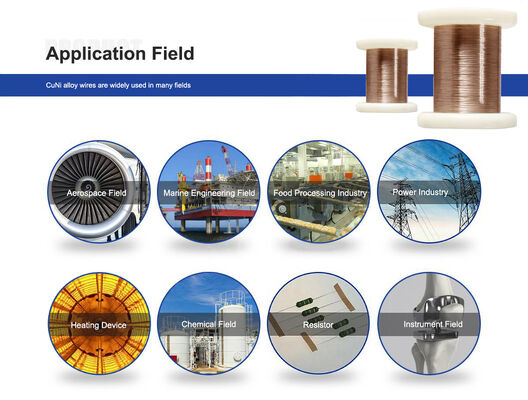
| Electrical Apparatus | Thermal overload relay windings, low-resistance circuit breaker heaters | Stable 0.12 μΩ·m resistivity + low TCR ensures consistent tripping characteristics across temperature range |
| Resistors & Potentiometers | Precision wire-wound resistors, shunt resistors, potentiometer windings | Resistivity independent of temper — your resistor value stays stable regardless of forming process |
| Heating Cables | Electric heating cables, trace heating, floor warming systems | Corrosion-resistant — no protective jacket degradation compromising heating element life |
| Automotive | Sensor resistors, actuator heater windings, battery management system shunt resistors | Handles under-hood temperature cycling without resistance drift — TCR low enough that ambient temperature changes don't affect circuit calibration |
| Industrial Controls | Motor overload protection, current sensing shunts, instrumentation resistors | Predictable performance over 20+ year service life in industrial environments |
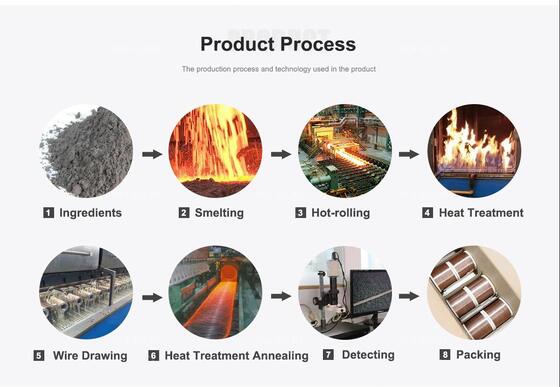
Changzhou DLX Alloy Co., Ltd. was founded in 2002 with a single focus: nickel-based specialty alloys — including the full CuNi alloy family from CuNi1 to CuNi44. We don't just draw wire; we melt, forge, roll, and draw under one roof with metallurgical control at every step.
Source: DLX Alloy product catalog. EN 10204 3.1 MTC with full composition included on every shipment.
| Element | Ni | Cu | Mn | Fe |
|---|---|---|---|---|
| Specification | 23.0 | Balance | 0.5–1.0 | ≤0.5 |
| Wire Diameter | 0.08–7.5 mm (per DLX CuNi catalog Wire range) |
| Grade | CuNi23 (NC030 equivalent) |
| Temper | Hard (cold drawn) or soft (annealed) — specify when ordering |
| Resistivity at 20°C | 0.12 μΩ·m — stable in both hard and soft conditions |
| TCR (20–600°C) | 50 * 10⁻⁶ /°C |
| Surface Finish | Bright, oxide (per customer requirement) |
| Packaging | Spooled on plastic or wooden reels; vacuum-sealed with desiccant |
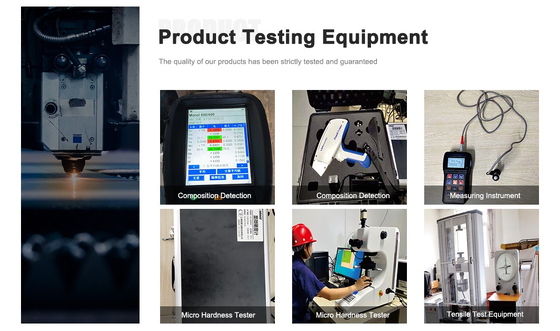
| Testing | OES chemical analysis, resistivity measurement, TCR verification, tensile, diameter inspection, surface quality |
| Stage | Test / Inspection | Standard |
|---|---|---|
| Melting / ingot | OES chemical analysis, Ni & Cu content verification | In-house / GB/T |
| Hot rolling / rod | Surface inspection, diameter check | In-house process spec |
| Cold drawing | In-line diameter monitoring at each pass, intermediate annealing verification | ± tolerance per diameter |
| Post heat treatment | Tensile test, elongation verification (soft temper) | Per order specification |
| Final spool | Resistivity measurement, TCR verification, eddy current (if specified), visual & dimensional audit | Per order specification |
| Documentation | EN 10204 3.1 MTC, resistivity & TCR test reports, certificate of conformance | ISO9001 |
Third-party inspection by SGS, BV, or TÜV available upon request. All shipments fully documented and traceable to heat number.
| Spool Types | Plastic reels (D55–D400) or wooden reels per customer specification |
| Packaging | Vacuum-sealed with desiccant, individually boxed; bulk orders on wooden pallets |
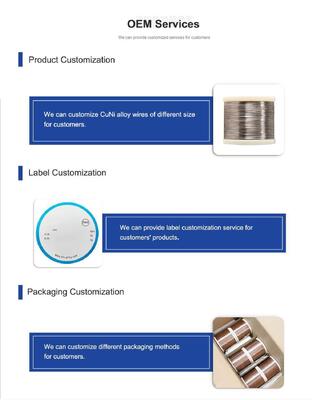
| Spool Label | Grade (CuNi23), heat number, diameter, temper, resistivity value, net weight, DLX traceability code |
| MOQ | 5 kg per diameter for fine wire (≤0.5mm); 30 kg per diameter for standard sizes; trial quantities supported |
| Lead Time | 3–7 days for stock items; 15–25 days for custom production orders |
| Shipping | Air freight (DHL, FedEx), sea freight (FCL/LCL), or customer-designated forwarder |
| Payment | T/T, L/C at sight |
Hard temper (cold drawn): higher tensile strength and stiffness, ideal for self-supporting straight heating elements, rigid resistor leads, and applications where the wire must hold its shape. Soft temper (annealed): maximum formability and ductility, ideal for winding, coiling, and applications requiring post-forming. Resistivity is the same — 0.12 μΩ·m — in both conditions. Not sure? Describe your forming process and we recommend within 24 hours.
Our standard resistivity tolerance is ±5% of nominal (0.12 μΩ·m ± 0.006). For precision applications requiring tighter tolerance, we can supply to ±3% or better. Each spool is individually measured and labeled with its actual resistivity value. Consistent from spool to spool, batch to batch.
CuNi23 has lower resistivity (0.12 vs 0.49 μΩ·m for CuNi44) and lower nickel content (23% vs 44%). CuNi23 is preferred when lower resistance values are needed in the same wire gauge, or when lower material cost is a priority. CuNi44 is preferred for high-resistance applications and thermocouple extension wire. We can supply both for your evaluation.
Yes. Trial quantities are available for all diameters and tempers. We encourage first-time buyers to verify resistivity, TCR, and mechanical performance in your specific application before committing to production volumes.
Yes. CuNi23 is readily solderable using standard tin-lead or lead-free solders with appropriate flux. Resistance welding and brazing are also suitable. No special surface preparation required beyond standard cleaning. We can supply with bright surface finish ready for joining operations.


 english
 français
 Deutsch
 Italiano
 Русский
 Español
 português
 Nederlandse
 ελληνικά
 日本語
日本語
 한국
한국
 中文
中文
 العربية
 हिन्दी
 Türkçe
 indonesia
 tiếng Việt
 ไทย
ไทย
 বাংলা
বাংলা
 فارسی
فارسی
 polski