
5s
+1
Submission successful!

|



| Brand Name: | DLX |
| Model Number: | 6J40 |
| MOQ: | 5kg |
| Payment Terms: | L/C,D/A,D/P,T/T,VTB |
| Supply Ability: | 1200 tons per month |
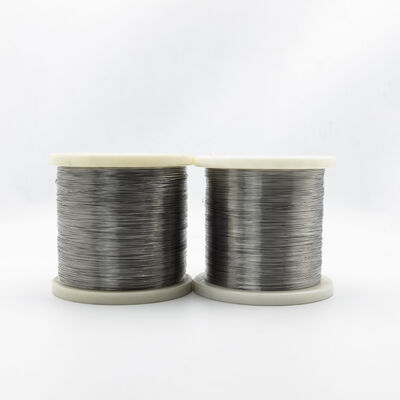
Premium 6J40 Constantan Resistance Wire is a specialized copper-nickel alloy engineered for high-precision electrical measuring apparatus and current-sensing applications. Featuring a nominal volume resistivity of 0.48 μΩ·m and an exceptionally low temperature coefficient of resistance (TCR), this material guarantees zero electrical drift across wide operational temperature ranges. Produced under strict melt-to-spool quality controls, DLX delivers ultra-fine to heavy-gauge wires with uniform bright-annealed surfaces and mirror-level dimensional accuracy.
6J40 Constantan (nominally 40% Nickel, balance Copper, with trace Manganese and Iron additives) is the premier resistance material for standard resistors, heavy-duty current shunts, and precision potentiometers. Its hallmark physical characteristic is an essentially flat resistance-versus-temperature curve around room and elevated ambient temperatures, eliminating measurement errors caused by self-heating.
Unlike commercial-grade wire, our premium 6J40 alloy undergoes ultra-pure vacuum induction melting (VIM) followed by controlled inert-gas continuous bright annealing. This ensures superior metallurgical homogeneity, consistent thermal EMF suppression against copper, and high oxidation resistance in both AC and DC instrumentation circuits.
| Element | Content (%) |
|---|---|
| Nickel (Ni) + Cobalt (Co) | 39.0 – 41.0 |
| Manganese (Mn) | 1.0 – 2.0 |
| Iron (Fe) | ≤ 0.50 |
| Carbon (C) | ≤ 0.05 |
| Silicon (Si) | ≤ 0.15 |
| Copper (Cu) | Balance |
| Property | Metric Value | Imperial / Notes |
|---|---|---|
| Nominal Electrical Resistivity (20°C) | 0.48 ± 0.03 μΩ·m | 288.7 Ω·circ.mil/ft |
| Temperature Coefficient of Resistance (TCR, 20°C to 100°C) | ± 15 × 10⁻⁶ / °C | Ultra-low thermal drift |
| Density | 8.90 g/cm³ | 0.322 lb/in³ |
| Melting Temperature | 1220 – 1280 °C | 2228 – 2336 °F |
| Thermal Conductivity (20°C) | 21.8 W/(m·K) | Rapid heat dissipation |
| Coefficient of Thermal Expansion (20°C–100°C) | 15.2 × 10⁻⁶ / K | Matches ceramic bobbins |
| Thermal EMF vs. Copper (0°C to 100°C) | -40 to -45 μV/°C | Standard thermoelectric output |
| Max Operating Temperature in Air | 500 °C | Continuous service |
| Wire Diameter Range (mm) | Tensile Strength (MPa) | Elongation A100 (%) | Surface Condition |
|---|---|---|---|
| 0.025 mm – 0.10 mm | 400 – 520 | ≥ 12 | Bright Annealed / Enamelled |
| 0.10 mm – 0.50 mm | 420 – 540 | ≥ 15 | Bright Annealed / Spooled |
| 0.50 mm – 3.00 mm | 440 – 560 | ≥ 20 | Bright / Oxidized / Coiled |
| > 3.00 mm (Rod/Bar) | 450 – 580 | ≥ 25 | Pickled / Cold Drawn |
Q1: What makes 6J40 Constantan superior to standard Copper-Nickel alloys for instrument shunts?
A1: 6J40 is formulated with precise manganese and iron ratios that flatten the temperature-resistance curve across normal ambient working ranges (0°C to 100°C), resulting in a TCR of less than ±15 × 10⁻⁶ / °C. This prevents measurement distortion during prolonged electrical loading.
Q2: What wire diameter ranges and insulation options can be supplied?
A2: We supply bare solid round wire from 0.025 mm to 8.0 mm, flat resistance ribbons/strips, and polyurethane/enamel-coated magnet wire versions for high-density coil winding.
Q3: How do you ensure resistance uniformity across long spool lengths?
A3: Every continuous heat-treated run is monitored via inline dynamic resistance sensors and automated laser micrometer gauging to keep linear resistance variations within ±1.5% of specified values.
Q4: Can 6J40 Constantan be welded directly to Copper terminals?
A4: Yes. 6J40 exhibits clean fusion properties and can be joined using TIG, electron-beam welding, resistance spot welding, or standard silver soldering techniques.
Q5: What packaging is standard for ultra-fine gauges (e.g., < 0.05 mm)?
A5: Ultra-fine wire is wound with constant-tension spoolers onto high-impact plastic spools, shrink-wrapped with desiccants, and packed in multi-layered foam-padded export cartons to prevent transit deformation.


 english
 français
 Deutsch
 Italiano
 Русский
 Español
 português
 Nederlandse
 ελληνικά
 日本語
 한국
 中文
 العربية
 हिन्दी
 Türkçe
 indonesia
 tiếng Việt
 ไทย
 বাংলা
 فارسی
 polski
