
5s
+1
Submission successful!

|


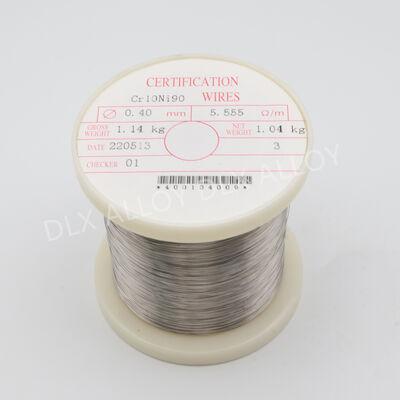
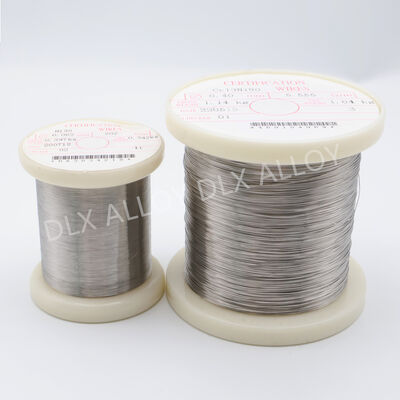
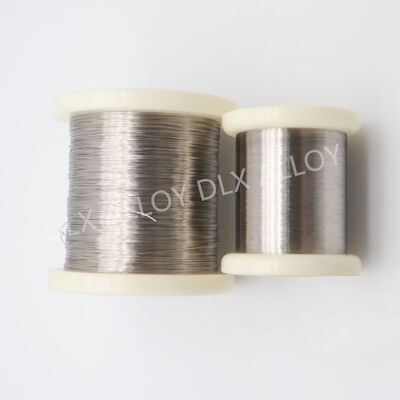
| Brand Name: | DLX |
| Model Number: | Nichrome Wire Cr10Ni90 |
| MOQ: | 10kg |
| Payment Terms: | L/C,D/A,D/P,T/T,Western Union |
| Supply Ability: | 1,200 Tons/Month |
Cr10Ni90 alloy wire, composed of 90% nickel and 10% chromium, is an engineered high-nickel resistance and electrode material designed specifically for industrial water electrolysis systems, including alkaline water electrolysis (AWE) and proton exchange membrane (PEM) auxiliary setups. With outstanding resistance to high-temperature alkaline corrosion, minimal overpotential drift, and stable electrical conductivity, Cr10Ni90 wire serves as an ideal material for electrode grids, heating elements, and internal structural leads in multi-megawatt electrolytic cells.
DLX manufactures precision Cr10Ni90 wire with stringent chemical batch control, uniform surface finish, and tight diameter tolerances, ensuring long-term operational stability and reduced maintenance downtime in continuous industrial hydrogen generation plants.
The Cr10Ni90 Wire is an advanced alloy made from 10% Chromium and 90% Nickel, offering superior resistance to corrosion and high-temperature stability. This wire is specifically engineered to function as the key electrode material in large-scale electrolyzers, where hydrogen is produced by splitting water molecules. The wire's exceptional mechanical properties make it highly suitable for industrial electrolysis processes, which involve continuous, high-efficiency operations in harsh electrolytic environments.
The Cr10Ni90 Wire is designed to ensure optimal performance in both alkaline electrolysis and proton-exchange membrane (PEM) electrolysis systems. With high melting points, excellent electrical conductivity, and exceptional resistance to corrosion, this alloy is the go-to material for efficient and long-lasting hydrogen production systems.
| Performance Parameter | Cr10Ni90 | Cr20Ni80 | Cr30Ni70 | Cr15Ni60 | Cr20Ni35 | Cr20Ni30 |
|---|---|---|---|---|---|---|
| Nickel Content (%) | Ni: Bal. (89.0-91.0) | Rest | Rest | 55.0-61.0 | 34.0-37.0 | 30.0-34.0 |
| Chromium Content (%) | 9.0-11.0 | 20.0-23.0 | 28.0-31.0 | 15.0-18.0 | 18.0-21.0 | 18.0-21.0 |
| Iron Content (%) | ≤0.50 | ≤1.0 | ≤1.0 | Rest | Rest | Rest |
| Maximum Continuous Working Temp (C) | 1300 | 1200 | 1250 | 1150 | 1100 | 1100 |
| Melting Point (C) | 1410-1420 | 1400 | 1380 | 1390 | 1390 | 1390 |
| Density (g/cm3) | 8.70 | 8.40 | 8.10 | 8.20 | 7.90 | 7.90 |
| Resistivity at 20C (uOhm.m) | 0.78±0.04 | 1.09±0.05 | 1.18±0.05 | 1.12±0.05 | 1.00±0.05 | 1.04±0.05 |
| Tensile Strength (Annealed, MPa) | 600-750 | 650-800 | 700-850 | 600-750 | 550-700 | 550-700 |
| Elongation at Break (A50, %) | ≥25 | ≥20 | ≥20 | ≥20 | ≥20 | ≥20 |
| Specific Heat Capacity (J/g.C) | 0.45 | 0.44 | 0.44 | 0.44 | 0.44 | 0.44 |
| Thermal Conductivity (W/m.K) | 21.5 | 15.0 | 13.5 | 13.8 | 13.0 | 13.0 |
| Linear Expansion Coefficient (20-1000C, 10-6/K) | 16.5 | 18.0 | 17.0 | 17.0 | 19.0 | 19.0 |
| Micrographic Structure | Austenite | Austenite | Austenite | Austenite | Austenite | Austenite |
| Magnetic Properties | Nonmagnetic | Nonmagnetic | Nonmagnetic | Nonmagnetic | Nonmagnetic | Nonmagnetic |
Superior Alkaline Electrolyte Corrosion Resistance The 90% nickel matrix forms a dense, self-passivating oxide layer in concentrated KOH and NaOH electrolyte solutions, preventing hydrogen embrittlement and surface pitting under high current density.
Stable Electrical Conductivity and Low Contact Resistance With a stable resistivity of 0.78 uOhm.m at 20C and low temperature coefficient of resistance, Cr10Ni90 ensures uniform current distribution across large electrolyzer stacks, reducing energy consumption per kilogram of hydrogen produced.
Elevated Temperature Mechanical Integrity Possessing an ultimate tensile strength of 600 to 750 MPa in annealed condition and high creep rupture strength up to 1300C, the wire maintains structural stability without sagging or deformation during cyclic thermal operations.
Excellent Formability and Weldability High ductility (elongation ≥25%) enables trouble-free cold drawing, weaving into electrode meshes, winding into specialized heating coils, and spot-welding to current collector plates.
| Nominal Diameter (mm) | Diameter Tolerance (mm) | Surface Finish | Supply Form |
|---|---|---|---|
| 0.05 - 0.10 | ±0.003 | Bright Annealed | DIN100 / DIN125 Plastic Spool |
| 0.12 - 0.50 | ±0.005 | Bright Annealed | DIN160 / DIN200 Spool |
| 0.55 - 1.20 | ±0.008 | Bright Annealed | DIN250 / DIN355 Spool |
| 1.25 - 3.50 | ±0.012 | Bright Annealed / Pickled | Coil with Waterproof Film |
| 3.60 - 8.00 | ±0.020 | Clean Surface / Pickled | Coil / Straight Rod |
At DLX, we understand the critical role that materials play in optimizing hydrogen production systems. Whether you're working on a small-scale project or scaling up to large industrial electrolyzers, DLX's Cr10Ni90 Wire offers the ideal combination of durability, corrosion resistance, and electrical conductivity.
Q1: What are the main advantages of Cr10Ni90 compared with Cr20Ni80 in hydrogen electrolysis?
A1: Cr10Ni90 contains 90% nickel, providing significantly higher corrosion resistance in strong alkaline electrolytes (such as 30% KOH) and better electrical conductivity (lower resistivity of 0.78 uOhm.m vs 1.09 uOhm.m of Cr20Ni80), making it more energy-efficient as an electrode lead material.
Q2: Can DLX provide custom wire diameters and spooling formats?
A2: Yes. DLX manufactures Cr10Ni90 wire ranging from ultra-fine 0.05mm up to 8.00mm. We provide various spooling configurations including DIN100, DIN160, DIN250 spools, as well as bulk coils and straightened rods tailored to automated mesh-weaving machines.
Q3: What quality inspection documents are provided with each shipment?
A3: Every batch is accompanied by an official Mill Test Certificate (MTC), including chemical spectrometer analysis (OES), tensile strength testing, electrical resistivity verification, and dimensional tolerance inspection data.
Q4: What is the minimum order quantity (MOQ) and sample policy?
A4: The standard MOQ for Cr10Ni90 wire is 5 kg. For technical verification and trial weaving, free 0.5 kg sample spools are available upon request.
Q5: Is Cr10Ni90 wire suitable for continuous operation in high-temperature electrolysis?
A5: Yes. With a maximum continuous working temperature of up to 1300C and an austenitic non-magnetic crystal structure, it delivers exceptional dimensional stability and oxidation resistance in both high-temperature steam and alkaline environments.


 english
 français
 Deutsch
 Italiano
 Русский
 Español
 português
 Nederlandse
 ελληνικά
 日本語
 한국
 中文
 العربية
 हिन्दी
 Türkçe
 indonesia
 tiếng Việt
 ไทย
 বাংলা
 فارسی
 polski
