5s
+1
Submission successful!

|


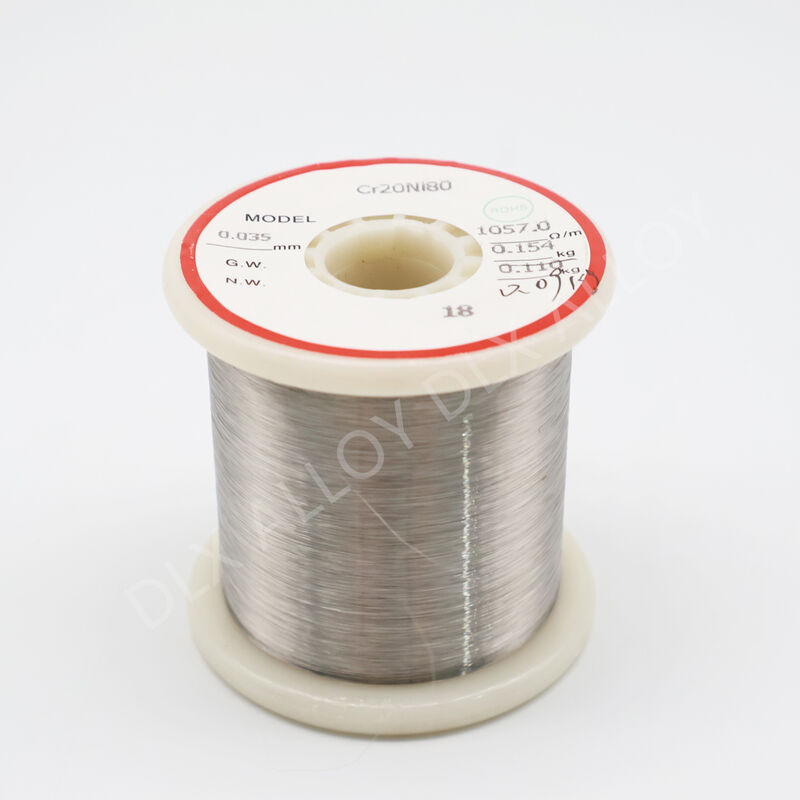
| Brand Name: | DLX |
| Model Number: | Nichrome Wire Cr20Ni80 |
| MOQ: | 10kg |
| Payment Terms: | L/C,D/A,D/P,T/T,Western Union |
| Supply Ability: | 500 tons per month |
High-Performance Cr20Ni80 Resistance Wire for Water Splitting & Hydrogen Generation Systems
Cr20Ni80 (Nickel-Chromium 80/20) resistance wire is a premium electrothermal alloy engineered for high-temperature solid oxide electrolysis cells (SOEC), steam electrolysis heating modules, and high-durability electrolyzer auxiliary heating systems. With a nominal composition of 80% Nickel and 20% Chromium, Cr20Ni80 delivers stable electrical resistivity (1.09 microhm-meter), exceptional hot-corrosion resistance, and superior structural stability up to 1200°C continuous working temperature.
DLX supplies precision-drawn Cr20Ni80 wire and flat ribbon with tight dimensional tolerances, fully annealed structure, and zero surface defects, ensuring high thermal conversion efficiency and extended operational life in industrial green hydrogen production equipment.
In high-temperature water splitting and SOEC hydrogen generation stacks, uniform thermal management is critical for electrolysis efficiency and stack longevity. Cr20Ni80 resistance alloy provides a stable temperature coefficient of resistance, maintaining precise thermal output during continuous operation.
Upon heating in oxidizing and steam-rich environments, Cr20Ni80 forms an adherent, protective chromium oxide (Cr2O3) surface layer. This passive oxide film effectively inhibits further internal oxidation and high-temperature degradation, preventing element sag or embrittlement across repeated thermal cycles. DLX provides comprehensive customization across wire spools, coils, and formed heating elements tailored to commercial electrolyzer designs.
| Technical Parameter | Specification / Value |
|---|---|
| Alloy Grade | Cr20Ni80 / Ni80Cr20 |
| Chemical Composition Ni | 78.0 - 81.0 % |
| Chemical Composition Cr | 20.0 - 23.0 % |
| Chemical Composition Fe | <= 1.0 % |
| Chemical Composition Mn | <= 0.7 % |
| Chemical Composition Si | 0.75 - 1.50 % |
| Chemical Composition C | <= 0.08 % |
| Maximum Continuous Operating Temperature | 1200 °C |
| Melting Point | 1400 °C |
| Density | 8.40 g/cm³ |
| Electrical Resistivity at 20°C | 1.09 ± 0.05 μΩ·m |
| Thermal Conductivity (100°C) | 60.3 kJ/(m·h·°C) |
| Coefficient of Linear Expansion (20-1000°C) | 18.0 × 10⁻⁶/K |
| Tensile Strength (Annealed state) | 650 - 750 MPa |
| Elongation at Rupture | >= 20 % |
| Micrographic Structure | Austenite (Non-magnetic) |
| Available Wire Diameters | 0.05 mm - 10.0 mm |
- Stable High Resistivity: Nominal resistivity of 1.09 microhm-meter provides high thermal conversion efficiency, reducing electrical power loss in electrolyzer heating circuits.
- Reliable 1200°C Thermal Endurance: High melting point (1400°C) and robust austenitic structure ensure resistance to deformation and element sag during prolonged high-temperature operation.
- Self-Healing Cr2O3 Protective Layer: Rapidly generates a dense, protective oxide surface in steam and air atmospheres, protecting against corrosive process gases and thermal degradation.
- Excellent Formability & Ductility: With elongation >= 20% in the annealed condition, the wire is easily coiled, bent, and fabricated into complex heating element geometries without cracking.
- Strict Resistance Tolerance: Diameter and resistance tolerance controlled within +/-3%, ensuring balanced heat distribution across multi-zone electrolyzer systems.
- Large-Scale Production Capacity: 1,200 tons monthly capacity guarantees steady raw material supply and rapid volume delivery for large-scale hydrogen infrastructure projects.
- In-House Quality Assurance: 100% PMI spectrometer chemical verification, tensile testing, and continuous resistance testing per coil before dispatch.
- Mill Test Certification: Full material traceability with EN 10204 3.1 Mill Test Certificates provided with every shipment.
- Complete Diameter Range: Automated fine wire drawing and annealing lines capable of producing diameters from 0.05 mm ultra-fine wire up to 10.0 mm heavy-gauge rod.
- Fast Sample Dispatch: 0.5 kg trial samples available with worldwide courier dispatch in 48 hours for lab evaluation and prototype testing.
As the world transitions to clean and sustainable energy, hydrogen is seen as one of the most promising solutions for decarbonizing multiple sectors, including transportation, energy, and industrial processes. Among the various hydrogen production technologies, water electrolysis is particularly attractive because it produces hydrogen with zero carbon emissions when powered by renewable energy sources.
As the demand for green hydrogen grows, so does the need for efficient and reliable electrolysis systems. Electrolysis technologies, including alkaline electrolysis and PEM electrolysis, are rapidly evolving, and the materials used in these systems play a crucial role in their efficiency and longevity. Cr20Ni80 Resistance Wire is poised to become a key material for the hydrogen economy, as its exceptional performance characteristics make it ideal for these demanding applications.
With government and industry support for hydrogen infrastructure expanding, the need for high-quality, durable materials like Cr20Ni80 Resistance Wire will continue to increase. By choosing DLX as your supplier, you ensure that your electrolysis systems are built with the best materials for long-term success.
DLX's Cr20Ni80 Resistance Wire is the optimal choice for ensuring that your hydrogen production systems operate at peak efficiency. Our wire combines outstanding durability, excellent conductivity, and resistance to corrosion, ensuring that your electrolyzers run smoothly for years to come. Whether you're involved in large-scale industrial production or groundbreaking research, DLX is your partner for high-performance materials.
Q: What is the primary function of Cr20Ni80 wire in hydrogen generation systems?
A: Cr20Ni80 functions primarily as a high-temperature heating element and thermal control alloy in SOEC steam electrolysis stacks, steam superheaters, and electrolyzer preheating systems operating up to 1200°C.
Q: How does Cr20Ni80 resist oxidation in high-temperature steam environments?
A: The 20% chromium content reacts with ambient oxygen to form a dense, adherent Cr2O3 oxide film on the surface, preventing deep oxidation and preserving electrical stability.
Q: What forms and sizes of Cr20Ni80 does DLX supply?
A: DLX supplies round wire (0.05 mm to 10.0 mm), flat ribbon, coiled heating elements, and stranded wire in bright annealed or oxidized surface conditions.
Q: What is the MOQ and standard packaging for international delivery?
A: Standard MOQ is 5 kg. Packaging includes DIN spools (DIN 100 to DIN 250) in export cartons or secure wooden crates for larger coils, complete with moisture-proof protection.
Q: Does DLX provide test certificates with the shipment?
A: Yes. Every batch is supplied with an EN 10204 3.1 Mill Test Certificate detailing actual chemical composition, resistance values, tensile strength, and heat number.


 english
 français
 Deutsch
 Italiano
 Русский
 Español
 português
 Nederlandse
 ελληνικά
 日本語
 한국
 中文
 العربية
 हिन्दी
 Türkçe
 indonesia
 tiếng Việt
 ไทย
 বাংলা
 فارسی
 polski